
India spent the last decade learning how to generate solar electricity at scale. The next chapter will be harder: making that electricity available when the grid actually needs it.
The Solar Paradox: When More Is No Longer Enough
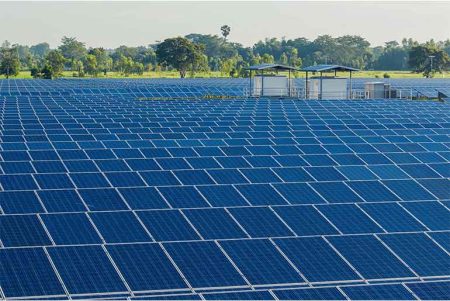
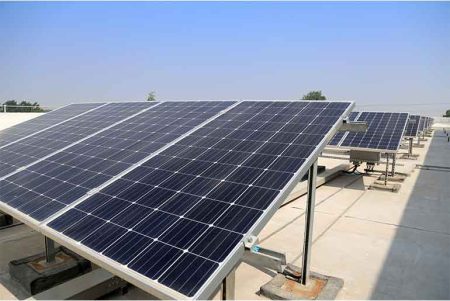
At noon, India’s solar story looks remarkably complete. Across utility-scale parks, factory rooftops, homes and hybrid projects, millions of photovoltaic modules are doing exactly what more than a decade of policy, investment and engineering intended them to do: turning an abundant Indian sun into electricity at extraordinary scale.
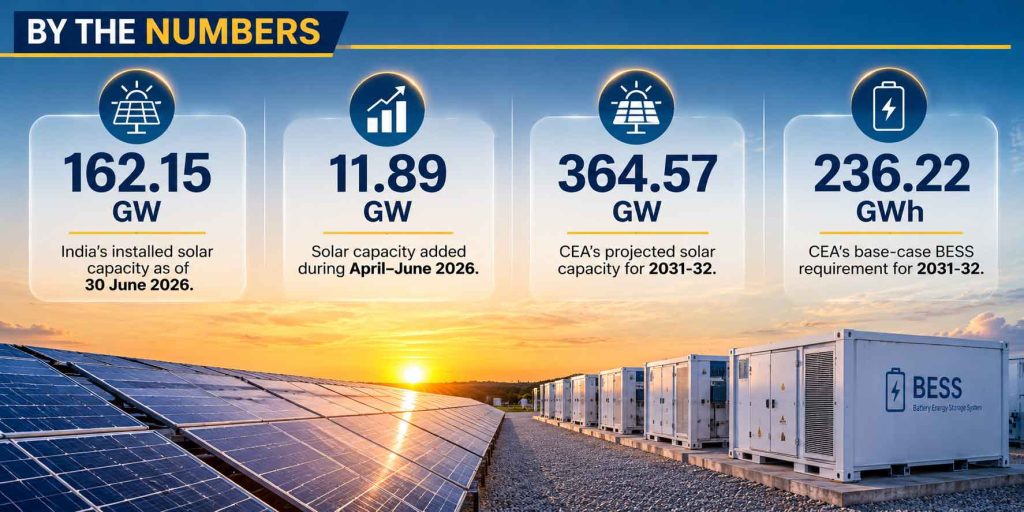
By 30 June 2026, India had 162.15 GW of installed solar capacity, including 121.25 GW of ground-mounted solar and 30.11 GW of grid-connected rooftop capacity. Nearly 11.9 GW was added in the first three months of FY2026-27 alone. In 2014, India’s solar fleet stood at just 2.82 GW. It is now roughly 57.5 times larger.
It is an extraordinary success. It has also brought India closer to solar power’s oldest limitation.
The sun sets. Electricity demand does not.
Factories continue producing. Metro trains keep moving. Data centres keep computing. Homes switch on lights and air-conditioners. Commercial loads continue well into the evening. Yet the fastest-growing source of generation on the system is simultaneously beginning its daily retreat.
For the first phase of India’s renewable transition, the central challenge was scale: build more capacity, lower tariffs, attract capital and generate more clean electricity. The next phase introduces a different question.
Not simply how much renewable electricity can India produce—but when can it deliver it?
That distinction is beginning to reshape the meaning of a solar project.
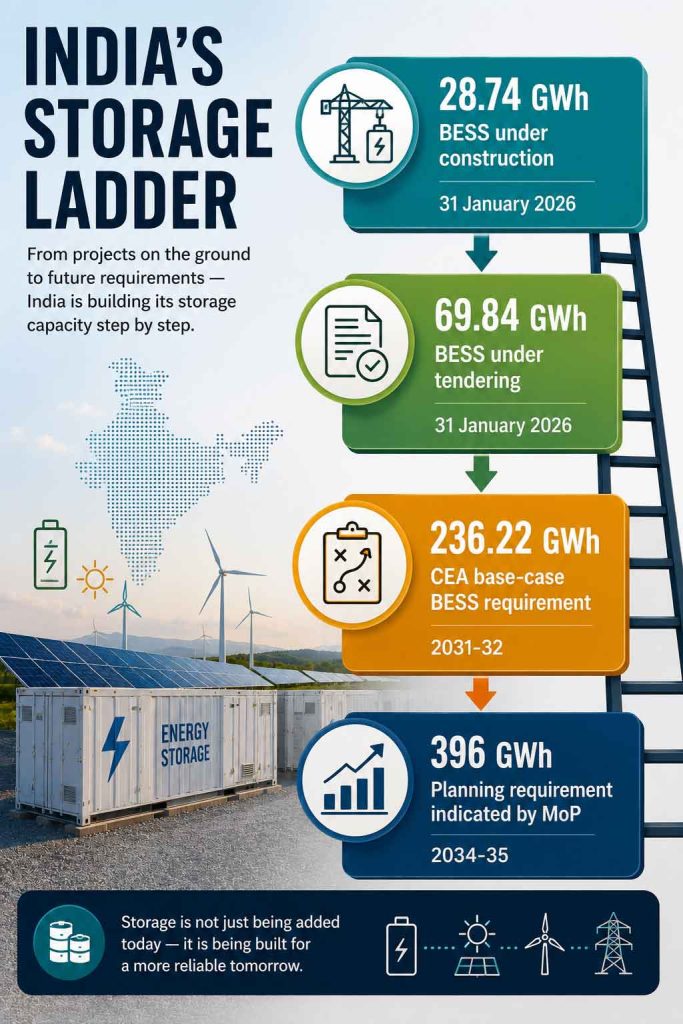
CEA’s National Electricity Plan envisages 364.57 GW of solar PV by 2031-32, accompanied by 121.90 GW of wind. But the same planning exercise also projects 47.24 GW/236.22 GWh of BESS and 26.69 GW of pumped storage in its 2031-32 base case.
The numbers tell a larger story. India’s electricity transition is moving from a race for renewable megawatts towards a search for renewable flexibility.
A megawatt tells us how large a power plant is. A megawatt-hour tells us how much electricity it produces or stores. Neither, by itself, answers the question that increasingly matters to a utility:
Will the electricity be there at the hour I need it?
This is not a weakness that invalidates solar. It is the next problem created by solar’s success.
And it is where the battery enters the story—not merely as a box that stores electricity, but as a technology capable of separating the hour of generation from the hour of use.
The question facing India’s power sector is therefore no longer whether solar can become one of the foundations of its electricity system. It already has.
The question is what happens after the sun becomes one of the grid’s largest generators.
The Flexibility Gap: Generation Is Only Half the Job
Solar’s variability is often reduced to one sentence: solar does not generate at night. For a power system, the problem is considerably more complex.
Electricity supply and demand must remain balanced continuously. Solar output changes with the movement of clouds, weather systems and seasons; forecast generation can differ from actual output; and every evening brings a predictable decline in solar production while consumer demand follows an entirely different curve. The Ministry of Power itself identifies intermittency and variability as central challenges of renewable integration.
The result is not simply an energy problem. It is a flexibility problem.
As solar production falls toward evening, something else must rise. That flexibility can come from hydro, pumped storage, thermal generation operating flexibly, stronger transmission, demand response, electricity markets or batteries. India’s future grid will almost certainly use a combination of them.
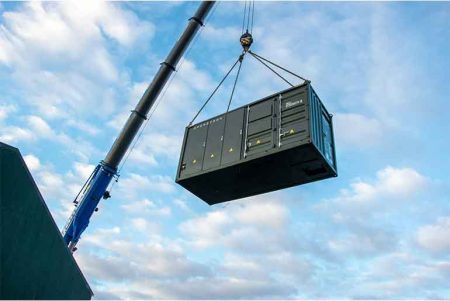
BESS, however, brings an unusual combination of attributes: it is modular, can be deployed at different points in the network and can alter its power output rapidly. A battery charged with surplus afternoon solar can discharge into an evening peak; the appropriate system can also support balancing and other grid requirements. Storage therefore does something solar alone cannot do: it gives the operator greater control over when renewable electricity becomes available.
That distinction becomes increasingly important as renewable penetration rises.
The Ministry of Power now estimates that non-fossil sources’ contribution to India’s gross electricity generation could rise from 25.5% in FY2024-25 to around 49.7% by FY2034-35. Its latest planning outlook indicates that around 99 GW/396 GWh of BESS, together with 62 GW of pumped storage, may be required by 2034-35.
But storage should not be presented as a magic cure.
A battery has a finite power rating, finite energy duration and finite state of charge. It cannot solve every transmission constraint simply by existing, and repeated cycling introduces degradation that ultimately affects project economics. Nor does every solar farm necessarily need a battery physically installed beside it. Flexibility may come from standalone BESS, pumped hydro, geographically diverse renewables, demand response or other resources elsewhere in the system.
The stronger proposition is this:
The more electricity a system derives from resources that cannot choose when they generate, the more valuable resources that can choose when they deliver become.
That is why India’s storage conversation is moving beyond the familiar idea of “saving solar for later.”
It is becoming a conversation about dependability.
And procurement is already beginning to reflect it. In June 2026, SECI issued an RfS for 4,800 MWh of assured peak supply—1,200 MW for four hours—from ISTS-connected renewable projects under FDRE-IX.
The phrase worth noticing is not merely renewable energy.
It is assured peak supply.
The buyer is beginning to ask renewable projects not only how cheaply they can generate electricity, but whether they can deliver it during specified hours.
Time has entered the renewable contract.
And once time has a price, storage begins to have a business case.
INDUSTRY PERSPECTIVE
Renewable energy has reached a scale where generation alone is no longer the industry’s biggest challenge. In your view, what fundamental shift in the power sector is making Battery Energy Storage Systems an increasingly indispensable component of future solar projects?
Dr Bhawani Singh Rathore, Founder Director and Global RE & BESS Trainer and Consultant, Kriti Productions and Two B Ecoinfra Pvt Ltd, said, “The global power industry is experiencing its most significant transformation since the introduction of interconnected transmission networks. Historically, power systems were designed around large synchronous generators whose rotating masses inherently provided inertia, fault current, voltage support and frequency stability. As conventional generation is progressively replaced by inverter-based renewable resources, these natural grid-stabilizing characteristics are rapidly diminishing.
Recent large-scale grid disturbances across different regions of the world have demonstrated that modern power systems are no longer challenged by a shortage of generation capacity. Instead, they are challenged by maintaining stability during rapid changes in generation, load and network conditions. Frequency excursions, voltage instability, declining system strength, oscillations, renewable curtailment and transmission congestion are becoming increasingly common operational concerns.
This represents a fundamental shift in power system philosophy—from maximizing electricity generation to maximizing grid flexibility, resilience and controllability.
Battery Energy Storage Systems are uniquely positioned to address these emerging challenges because they respond within milliseconds, unlike conventional thermal generation. Modern utility-scale BESS can simultaneously provide fast frequency response, synthetic inertia, voltage regulation, reactive power support, black-start capability, congestion management and renewable firming while improving asset utilization across the transmission network.
In my opinion, the future role of BESS extends far beyond storing energy. It is becoming an essential grid stability asset. Future renewable projects will therefore be evaluated not by the amount of electricity they produce, but by their ability to maintain secure, stable and dispatchable operation under increasingly dynamic grid conditions.
Hiren Pravin Shah, Founder & MD and CEO – Replus Engitech, said, “The power sector is moving from an energy-deficit mindset to a time-and-quality-of-supply mindset. When solar capacity was limited, every additional unit of generation helped. At higher penetration, however, large volumes arrive during the same daytime window, while demand often peaks after sunset. The value of a solar project therefore depends increasingly on whether its output can be shifted, shaped and delivered when the grid actually needs it.
BESS addresses this mismatch in several ways. It can absorb midday surplus, reduce curtailment, support evening ramping and provide fast frequency response.Through a suitably configured power-conversion system and control architecture, it can also support voltage management and respond to changing grid conditions. Storage gives developers greater control over scheduling and helps utilities manage forecast errors without depending entirely on thermal flexibility.
For future solar projects, storage will need to be considered at the design stage rather than added later as an accessory. Duration, cycling profile, thermal management, degradation, augmentation and control architecture all influence the performance of the combined asset over its life. The CEA’s projection of 236.22 GWh of BESS requirement by 2031–32 underlines the scale of this transition. At REPLUS, we see the decisive shift as one from producing renewable energy to delivering dependable renewable power, with the battery, Battery Management System (BMS), Energy Management System (EMS), and Power Conversion System (PCS) engineered as a unified operating platform.”
The Battery Doesn’t Store Electricity. It Stores Time
A solar panel and a battery perform fundamentally different jobs. One harvests energy; the other decides when that energy can become useful.
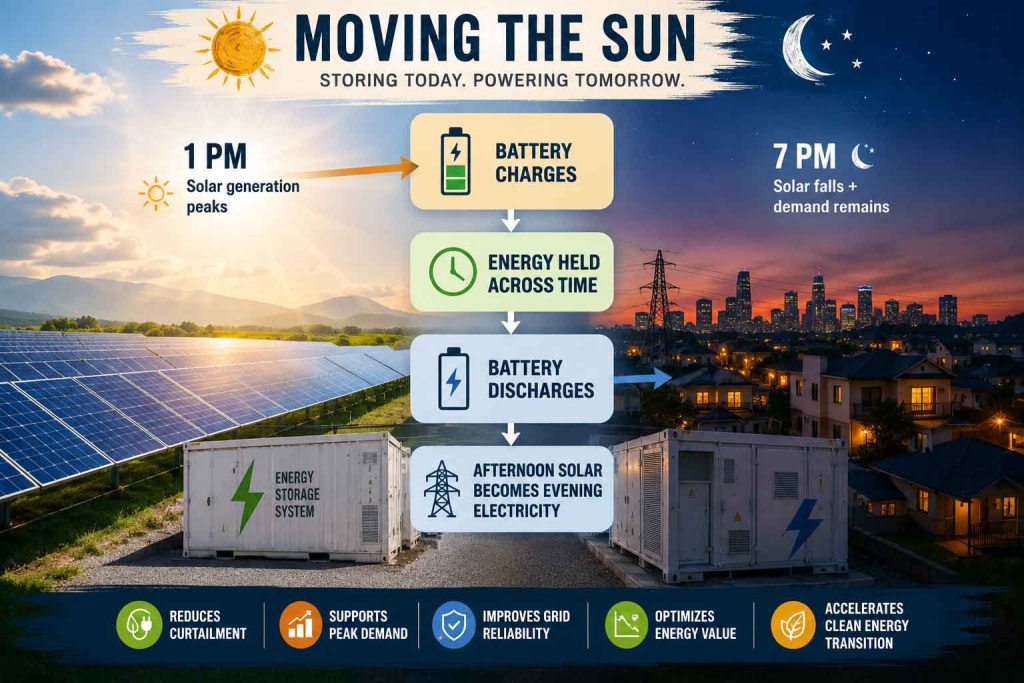
Consider a megawatt-hour generated at 1 PM, when solar output is abundant. Without storage, that electricity must essentially be consumed, exported or managed when it is produced. Put it into a battery, and something changes: the electricity acquires a degree of temporal flexibility. It can potentially reappear at 7 PM, when solar generation has fallen and the grid may value additional supply much more.
That simple shift—from 1 PM to 7 PM—sits behind some of BESS’s most important applications.
For a solar project, it enables energy shifting. For a DISCOM, it can support peak management. For the grid, appropriately configured BESS can respond rapidly to changing system conditions and participate in services such as frequency regulation. For developers facing scheduled delivery obligations, storage provides another tool for shaping renewable output around the contracted requirement.
But the battery’s usefulness depends on a number that is often overshadowed by MW: MWh.
A 100 MW/100 MWh battery and a 100 MW/400 MWh battery can both discharge at 100 MW, but the latter nominally carries four times the energy capacity. One is broadly a one-hour system; the other, a four-hour system at rated power. That difference can completely change the job the asset is capable of performing.
And duration increasingly matters in India. SECI’s June 2026 FDRE-IX tender sought 1,200 MW of assured peak supply for four hours, while other procurements have been structured around different delivery windows. The emerging market is therefore not simply asking, How many MW of batteries do we have? It is asking, how long can those MW remain useful?
Storage also has boundaries. A discharged battery cannot continue serving the evening peak. A full battery cannot absorb unlimited midday surplus. Every cycle contributes to degradation, while round-trip losses mean not every unit charged returns as a unit delivered. Duration, state of charge, cycling strategy, augmentation, thermal management and software therefore become part of the economics.
This is why BESS should not be understood as a warehouse for electrons. It is better understood as a control layer between generation and demand. Solar determines when electricity is born. Storage gives the system some choice over when that electricity is used.
When the PPA Learnt to Tell Time
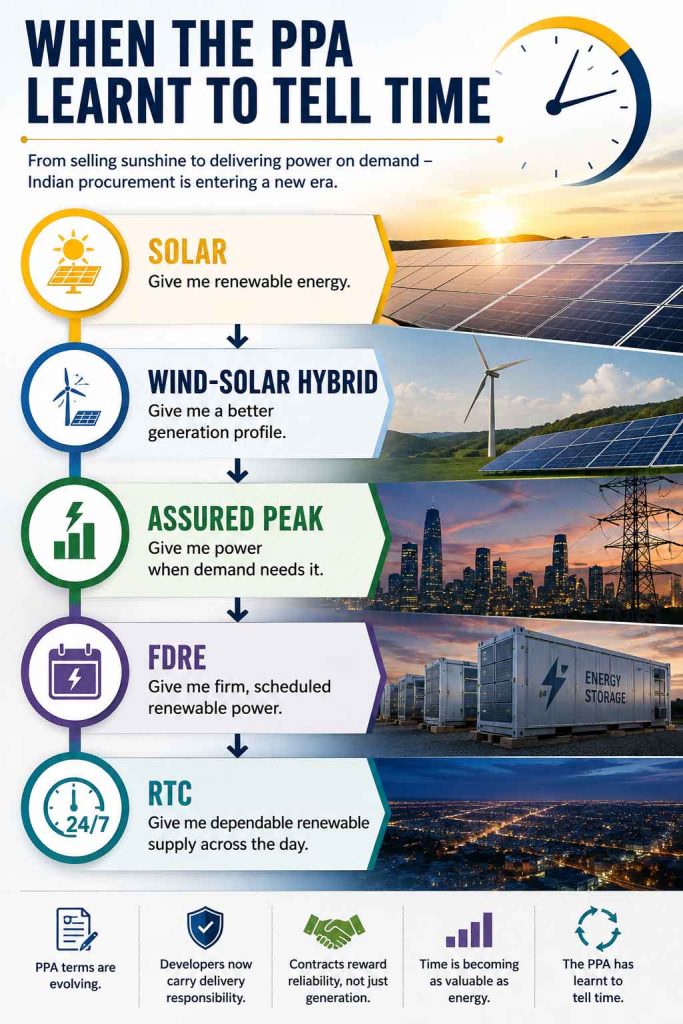
For years, the success of a solar project could be expressed largely through familiar numbers: capacity, generation, CUF and tariff. Increasingly, another variable is entering the contract—the hour of delivery.
India’s procurement journey shows the transition clearly. Wind-solar hybrid tenders first sought to improve the generation profile by combining two variable resources with different production patterns. Storage pushed the idea further: instead of merely diversifying when electricity is generated, developers could begin controlling when part of it is delivered.
By 2026, that shift had become difficult to miss. In April, SECI invited bids for 1,000 MWh of assured peak supply—500 MW for two hours—from ISTS-connected renewable projects under a Contract for Difference mechanism. In June, its FDRE-IX procurement sought 4,800 MWh—1,200 MW for four hours—of assured peak supply. SECI had also issued an RfS in March for 1,000 MW of Firm and Dispatchable Renewable Energy Round-the-Clock power.
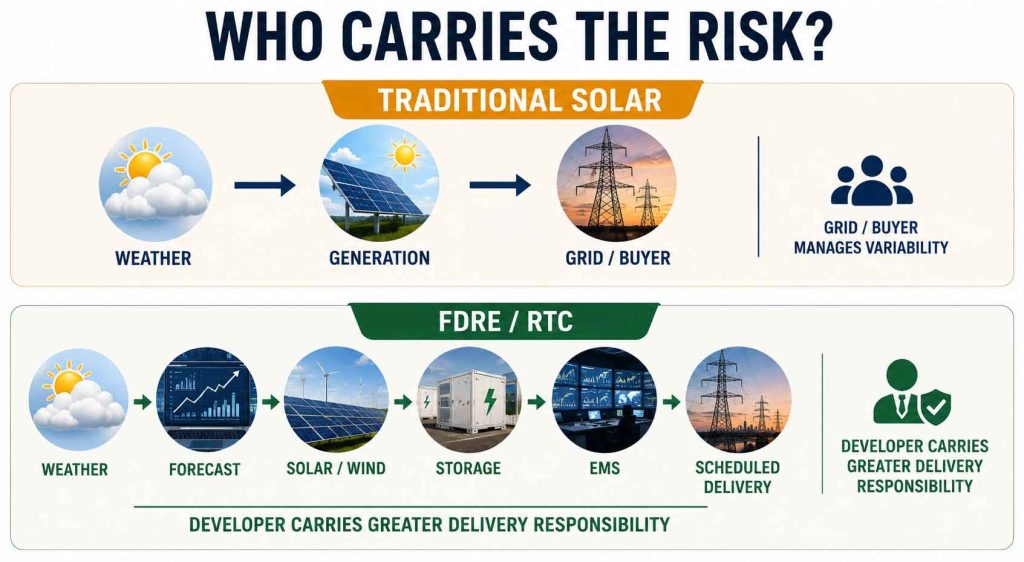
These are not merely new tender acronyms. They represent a redistribution of risk.
In a conventional solar project, weather largely determines the generation profile and the wider system manages much of the resulting variability. Under firm, peak or RTC obligations, the developer increasingly has to engineer around a promised delivery profile. Forecasting, storage duration, state of charge, round-trip losses, degradation, augmentation and the coordination of solar, wind and storage through an EMS can therefore become commercial questions—not just engineering ones.
That is also why FDRE should not be treated as another name for BESS. Firm renewable supply may combine solar, wind, BESS, pumped storage or other eligible resources depending on tender conditions. The Ministry of Power’s competitive-bidding framework for firm and dispatchable renewable power with energy storage has provided the policy architecture for this evolving market.
The direction, however, is unmistakable.
Solar asked: How cheaply can you generate?
Hybrid asked: Can you improve the generation profile?
Peak supply asks: Can you deliver during these hours?
FDRE asks: Can you follow a defined supply obligation?
RTC asks: How close can renewable power come to dependable, around-the-clock delivery?
The PPA is no longer buying sunshine alone.
It is beginning to buy time.
INDUSTRY PERSPECTIVE
Technologies such as renewable hybrids, peak shifting, ancillary services, Firm & Dispatchable Renewable Energy (FDRE), and Round-the-Clock (RTC) power are rapidly changing how utilities and developers evaluate renewable assets. Which of these developments do you believe will have the greatest long-term impact on the adoption of BESS, and why?
Dr Bhawani Singh Rathore, Founder Director and Global RE & BESS Trainer and Consultant
Kriti Productions and Two B Ecoinfra Pvt Ltd, said, “Among all evolving applications, I believe ancillary services will ultimately become the most transformative driver of Battery Energy Storage System deployment worldwide.Energy is becoming a commodity. Grid stability is becoming a premium service.
Power systems with high renewable penetration require continuous balancing between generation and demand while maintaining strict frequency and voltage limits. Traditional thermal generators were never designed to respond at the speed now required by modern electricity networks. Utility-scale BESS can deliver full active power within milliseconds, making them uniquely suited for frequency regulation, synthetic inertia, voltage support, spinning reserve, black-start capability and dynamic reactive power compensation.
The long-term value of these services extends beyond individual projects. They reduce transmission constraints, improve renewable hosting capacity, defer expensive network expansion and enhance overall system reliability.
Another important evolution is that utilities are beginning to procure grid flexibility rather than merely energy. This represents a fundamental change in project economics.However, achieving these benefits requires much more than installing battery containers. Performance depends on proper system engineering, including battery chemistry selection, power conversion architecture, EMS algorithms, protection philosophy, grid-forming inverter capability, thermal management and lifecycle optimization.
In the coming decade, successful developers will not compete on installed megawatts alone. They will compete on how effectively their assets support the stability, security and resilience of increasingly renewable-dominated electricity systems.”
Hiren Pravin Shah, Founder & MD and CEO – Replus Engitech, said, “FDRE and RTC procurement will have the deepest long-term impact on BESS adoption because they change the commercial promise of a renewable project. Peak shifting and ancillary services create important revenue streams, but FDRE and RTC contracts require developers to supply power across defined time blocks, including periods when solar output is weak or unavailable. Failure to meet these commitments can result in steep penalties and weaken project economics, which is why integrated engineering and lifecycle guarantees become non-negotiable.
This commercial exposure makes storage a central part of the delivery architecture, although the exact technology mix will depend on the renewable profile and tender conditions. In some projects, BESS may work alongside wind, pumped storage or other balancing resources. What matters is the ability to meet a contracted duty cycle with predictable availability and performance.
The shift also changes how systems are sized and operated. A battery selected only for short peak shaving may not be suitable for repeated, multi-hour discharge linked to firm supply commitments. Developers will need to model renewable generation, demand obligations, state of charge, round-trip losses, degradation and augmentation over the contract period. The EMS will be equally important because it must coordinate forecasting, charging, dispatch and reserve margins in real time. Consequently, under-sizing or improper thermal management becomes a massive financial risk, not just a technical oversight.
Recent FDRE and RTC procurement shows that utilities are already moving towards assured renewable delivery. At REPLUS, we believe this trend will create sustained demand for integrated engineering, lifecycle guarantees and intelligent energy management across the BESS value chain.”
THE THINKING POINT
The two answers expose an important debate rather than repeating one another.
Dr Rathore’s argument: the ultimate value of BESS may lie in what happens on the grid between electricity transactions—frequency, voltage, system strength and stability.
Hiren Shah’s argument: the faster commercial trigger may be what happens inside the contract—when developers become responsible for delivering renewable power according to time, availability and performance obligations.
One is the physics of flexibility.
The other is the economics of commitment. India’s storage market may ultimately be driven by both.
When Storage Stopped Being Just a Cost
For much of the solar industry’s growth, adding a battery meant adding cost. The solar plant generated electricity; storage required additional cells, PCS, controls, thermal management, fire protection, civil works and financing. That equation has not disappeared—but it is changing quickly.
BloombergNEF’s 2025 battery price survey put the global volume-weighted average lithium-ion pack price at $108/kWh. More strikingly for this story, average stationary-storage pack prices fell to $70/kWh, 45% lower than in 2024.
But $70/kWh is not the installed cost of a BESS. A complete project still carries the cost of power conversion, EMS/BMS, transformers, HVAC, safety systems, EPC, interconnection, warranties and eventual augmentation. For developers, the more useful question is therefore not how cheap has the battery become? but what additional value can that battery create over its life?
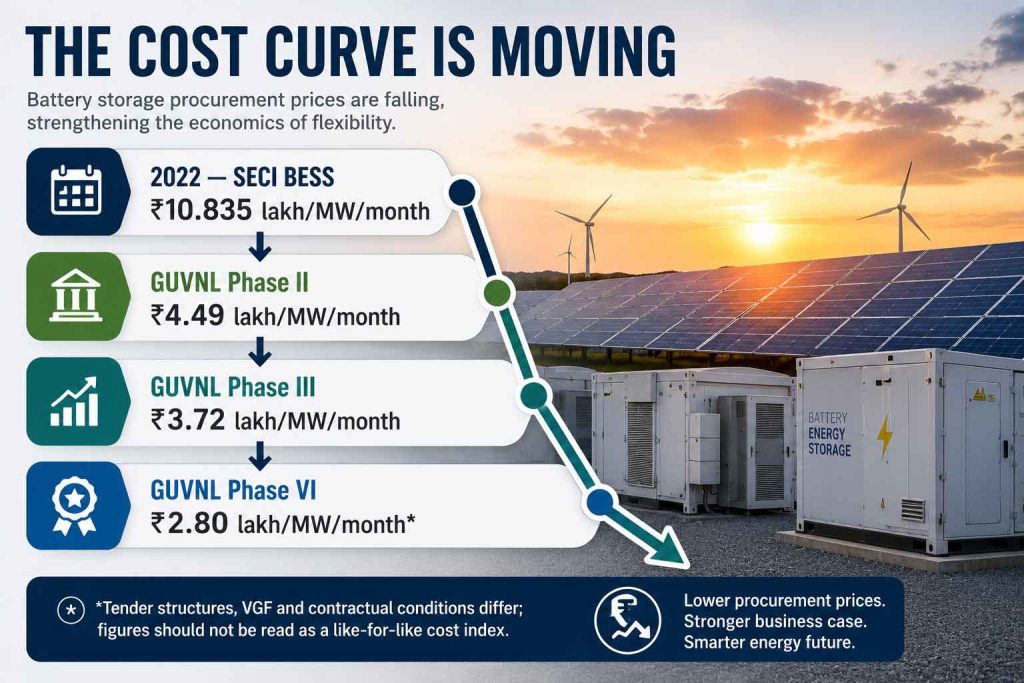
India’s auctions show how rapidly the commercial landscape is moving. SECI’s landmark 2022 standalone 500 MW/1,000 MWh procurement discovered a monthly capacity charge of ₹10.835 lakh/MW. Subsequent procurements have moved substantially lower; GUVNL Phase VI, for example, discovered winning charges of ₹2.80 lakh/MW/month and ₹2.856 lakh/MW/month for two-hour systems. The comparison is not perfectly like-for-like—VGF, contractual conditions and project structures differ—but the direction of competitive pricing is significant.
Policy is helping bridge the remaining gap. India’s first major VGF programme allocated ₹3,760 crore for 13.22 GWh of BESS under implementation, while another ₹5,400 crore scheme was approved to support 30 GWh, with VGF of ₹18 lakh/MWh.
Yet cheap capacity alone will not make a project bankable. Every cycle affects degradation. Round-trip losses matter. Batteries may require augmentation to maintain contracted performance over long PPAs. An aggressive bid that underestimates thermal management, cycling or replacement requirements can simply push today’s savings into tomorrow’s liabilities.
The economics of storage therefore marks an important departure from solar.
With solar, the industry became exceptionally good at asking:
What is the cheapest unit I can generate?
With storage, it must ask:
What is a dependable unit delivered at the right hour actually worth?
THINKING POINT | ONE BATTERY, MANY VALUES
Energy shifting + Peak capacity + Ancillary services + Renewable firming + Congestion management
But these cannot simply be added together as guaranteed revenues.
A battery has one state of charge, finite MWh and a finite cycling life. The real business case lies in deciding which service creates the greatest value at a particular time.
India’s Great Storage Build-Out
The economics explains why storage is becoming possible. The scale of India’s future electricity system explains why it may become necessary.
CEA’s National Electricity Plan projects 47.24 GW/236.22 GWh of BESS by 2031-32 in its base-case scenario, alongside 26.69 GW/175.18 GWh of pumped storage. Combined, that is more than 411 GWh of projected storage requirement.
And the requirement continues to rise beyond that horizon. The Ministry of Power’s latest planning outlook indicates around 99 GW/396 GWh of BESS and 62 GW of pumped storage may be required by 2034-35.
The market is already responding. As of 31 January 2026, the Ministry reported 10.66 GW/28.74 GWh of BESS under construction and another 22.35 GW/69.84 GWh under tendering.
Those categories matter. A tender announcement is not a commissioned battery. An award is not construction. And construction is not operational performance. As investment accelerates, India’s storage story will increasingly be determined by how effectively those gigawatt-hours travel from tender document to functioning grid asset.
Nor will batteries build the storage system alone. CEA’s own modelling shows that greater hydro and pumped-storage availability reduces the BESS requirement. In its higher hydro/PSP scenario for 2031-32, projected BESS falls from 236.22 GWh to 193.55 GWh.
The real competition, therefore, is not battery versus water. India needs a portfolio of flexibility resources suited to different durations, locations and system requirements.
And this is becoming a major infrastructure cycle. In July 2026, the Ministry of Power estimated investment associated with the NEP’s projected 2031-32 requirement at approximately ₹3.49 lakh crore for BESS and ₹1.29 lakh crore for pumped storage—about ₹4.78 lakh crore combined.
The opportunity is enormous.
So is the execution test: financing, grid connectivity, cells, PCS, safety, warranties, skilled EPC capacity, degradation assumptions, augmentation and recycling will determine whether India’s storage ambition becomes operating infrastructure.
The next storage race will not be won by the country that tenders the most GWh. It will be won by the one that successfully operates them.
 BIG NUMBER
₹4.78 LAKH CRORE
Indicative investment associated with CEA’s projected BESS + PSP requirement for 2031-32, according to the Ministry of Power.
The Grid That Can Remember
By 2035, the relationship between solar and storage may no longer be described as one technology supporting another. Increasingly, they will form parts of a single, digitally coordinated power asset.
The change begins with intelligence. A future Energy Management System will not simply decide when a battery charges and discharges. It will continuously interpret solar and weather forecasts, electricity demand, state of charge, battery health, contracted delivery obligations, grid signals and potentially market prices. BMS, EMS and PCS will increasingly work together to decide not only how much energy is available, but what the most valuable use of that energy is at a particular moment.
The inverter is evolving too. As inverter-based solar and wind replace part of the synchronous generation traditionally supporting electricity systems, grid-forming technologies are gaining importance. CEA’s publication of work on the manufacturing capacity of grid-forming inverters in India in February 2026 is an early indication that this transition is already entering India’s planning conversation.
Yet tomorrow’s flexibility will not necessarily sit beside the solar farm. Thousands of distributed batteries, rooftop systems, flexible industrial loads and eventually bidirectional EVs could be coordinated through Virtual Power Plants, turning small assets into aggregated grid resources. IEA’s 2026 analysis of Vehicle-to-Grid technology similarly points to the potential for EV batteries to provide peak reduction and grid services, although interoperability, regulation, compatible vehicles and consumer incentives remain significant barriers.
Nor will lithium-ion solve every time problem. Batteries are particularly attractive for short-duration flexibility, while pumped hydro and emerging long-duration technologies can address different requirements. Demand itself can become flexible: sometimes it may be cheaper to move consumption towards the solar-rich afternoon than move electricity towards the evening.
The power plant of 2035 may therefore be judged less by what stands behind its fence and more by what it can promise at the grid connection point.
Generation will remain fundamental.
But flexibility, reliability and dispatchability will increasingly determine what that generation is worth.
INDUSTRY PERSPECTIVE
Looking towards 2035, how do you envision the relationship between solar power and battery storage evolving? Will future renewable projects be evaluated primarily by the energy they generate, or by the flexibility, reliability and dispatchability they can deliver to the grid?
Dr Bhawani Singh Rathore, Founder Director and Global RE & BESS Trainer and Consultant, Kriti Productions and Two B Ecoinfra Pvt Ltd, said, “By 2035, I believe the global electricity sector will fundamentally redefine how renewable assets are valued. Installed capacity and annual energy generation will remain important metrics, but they will no longer determine project success.
Future power systems will reward predictability, flexibility, resilience and dispatchability.
Solar photovoltaic generation will increasingly become the primary source of low-cost energy, while Battery Energy Storage Systems will become the intelligence layer that transforms variable generation into dependable electricity. Advanced Energy Management Systems, AI-based forecasting, digital twins and grid-forming inverters will operate together to optimize charging strategies, network support, battery health and market participation in real time.
One significant industry transition will be from energy markets toward flexibility markets, where services such as frequency regulation, voltage support, congestion management, inertia and capacity availability become equally valuable as energy itself.
Another important evolution will be the integration of BESS into transmission planning rather than treating it solely as a renewable accessory. Utilities will increasingly deploy storage to strengthen grid reliability, improve resilience against extreme weather events and enhance recovery following major disturbances.
My view is straightforward: the next generation of renewable power plants will be designed as grid assets rather than energy assets. By 2035, the benchmark for project success will not be how many megawatt-hours are generated during daylight hours, but how reliably clean electricity can be delivered whenever and wherever the grid requires it.”
Hiren Pravin Shah, Founder & MD and CEO – Replus Engitech, said, “By 2035, solar and battery storage will increasingly be planned, financed and operated as a single power asset. Solar will continue to determine how much low-cost renewable energy is available, but storage will determine how much can be converted into a reliable grid product. The technologies will retain distinct functions, yet their value will be assessed together.
Generation will remain important; a poorly performing solar plant cannot be rescued by a battery. Future projects, however, will also be judged on schedule adherence, evening-peak support, response to grid instructions, availability and performance after years of cycling. A project producing slightly fewer units but delivering them more predictably may be more valuable than one maximising midday output while increasing stress on the grid.
Storage configuration will become application-specific. Frequency regulation, four-hour peak supply, firm renewable delivery, microgrid support and black-start capability require different power-to-energy ratios and operating strategies. This will place greater emphasis on accurate sizing, thermal design, augmentation planning and software controls.
At REPLUS, we expect the BMS, EMS and PCS to function together as the intelligence layer, or operating brain, of hybrid assets. The BMS will oversee state estimation, battery health and cell-level safety, while the EMS will coordinate forecasting, charging and dispatch, supported by the PCS for grid-facing power control. By 2035, flexibility, reliability, and dispatchability will no longer be premium add-ons; they will be the standard by which all renewable generation is measured.”
The Verdict: Does Every Solar Project Really Need a Battery?
Perhaps not every solar farm will eventually have a battery physically standing beside it.
Some flexibility will come from standalone BESS. Some from pumped storage. Some from stronger transmission, wind-solar complementarity, demand response, flexible generation and eventually distributed resources such as EVs. CEA’s own modelling makes this clear: when greater hydro and pumped-storage capacity is assumed, the BESS requirement itself falls.
So the real inevitability is not a battery beside every solar panel.
It is flexibility somewhere between generation and dependable delivery.
And BESS has emerged as one of the most versatile ways of providing it.
That distinction matters because India’s first solar revolution was essentially a revolution of quantity. It transformed a marginal generation technology into more than 162 GW of national capacity.
The next revolution will be about quality of delivery: whether clean electricity can be shifted, shaped, scheduled and dispatched around the requirements of an increasingly complex grid.
In that electricity system, the winning renewable project may not necessarily be the one that produces the greatest number of units at noon. It may be the one that can make those units matter at 7 PM.
For more than a century, electricity largely lived in the present: generated and consumed almost simultaneously.
Solar changed where that electricity could come from.
Storage is changing when it can arrive.
And that may ultimately prove just as transformative.
 Electrify your feed! Click here to join our Whatsapp group and to get the latest updates, expert insights, and innovations driving India’s energy storage revolution.