If you are trying to estimate BESS EPC Cost, the first mistake is to look for one universal ₹/MWh number. A battery energy storage project is not priced by battery capacity alone. The final figure depends on what the EPC contractor is actually responsible for—from the battery and PCS to electrical and civil Balance of Plant, controls, grid integration, testing, commissioning and long-term obligations.
This becomes especially important when you compare Indian BESS tenders. Two projects may have the same MW and MWh rating but completely different commercial boundaries. One tender may include the battery, PCS, EMS and complete BoP, while another may procure the battery package separately and ask an EPC contractor to deliver only the AC-side infrastructure.
So, before asking “What is the BESS EPC Cost per MWh?”, ask a more useful question:
“What exactly is included in the price?”
That is where a realistic BESS cost assessment begins.
BESS EPC Cost Is Not the Same as Storage Tariff
Indian storage procurement has produced some striking headline numbers in recent years. The Ministry of Power has reported that the discovered cost of BESS through tariff-based competitive bidding declined from around ₹10.18/kWh in 2022–23 to about ₹2.1/kWh in recent bids, based on two cycles per day.
But you should not read ₹2.1/kWh as the EPC cost of building a BESS.
It is a storage-service/capacity tariff derived through a particular procurement structure.
The distinction matters.
An EPC contractor is pricing the physical development and delivery of the plant. A developer bidding for a storage-service contract is calculating what tariff is required to recover capital expenditure, financing, operation, maintenance, degradation and other project costs over the contract period.
These are different financial numbers.
The same caution applies when you see figures quoted in ₹/MW/month. A tariff such as ₹3.59 lakh/MW/month tells you about the contracted storage service; it does not automatically tell you how much the underlying BESS EPC package cost.
This is why any serious discussion of BESS EPC Cost in India needs to separate CAPEX, EPC price, project cost and storage tariff rather than placing them in one bucket.
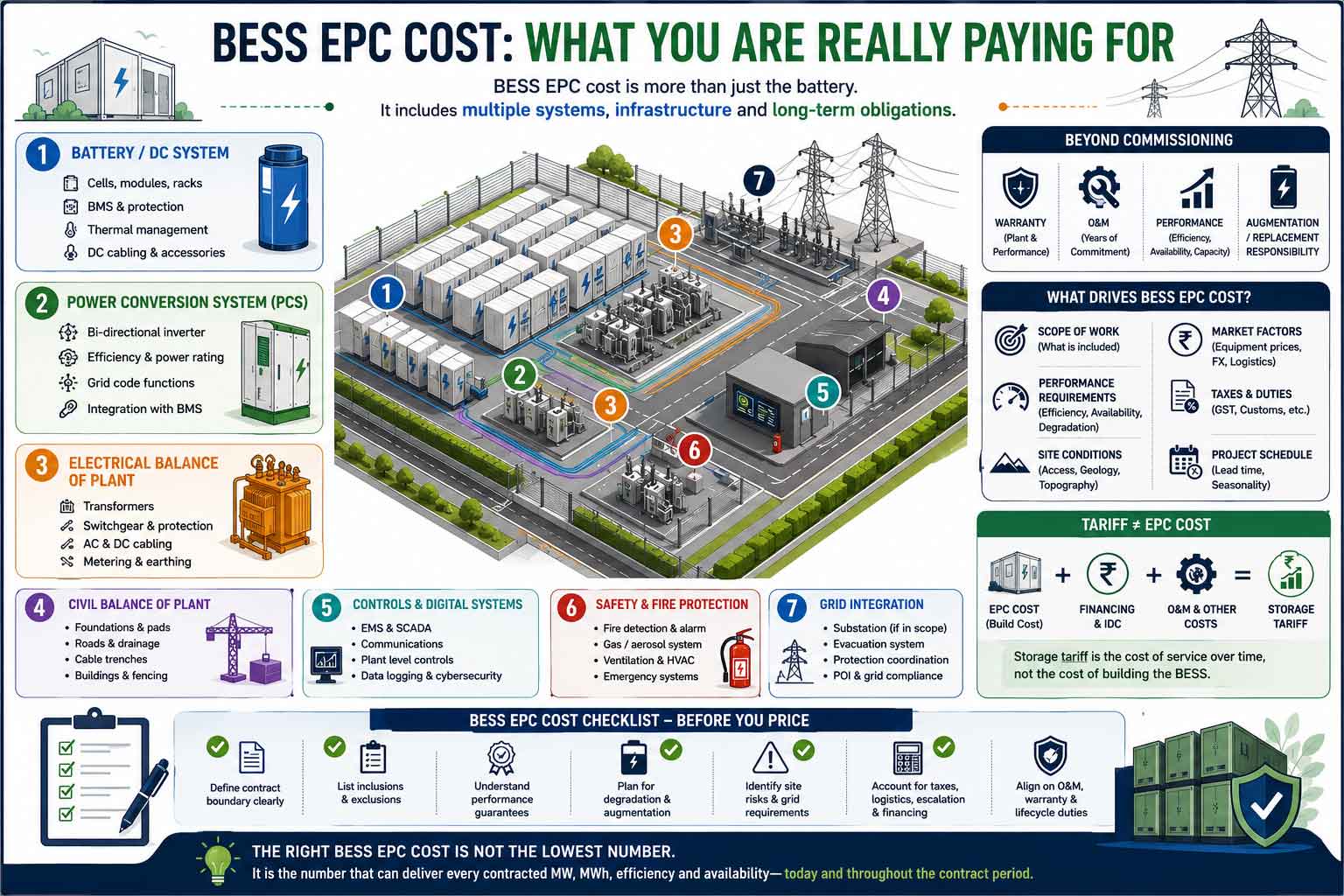
What Actually Makes Up BESS EPC Cost?
If you are preparing a BESS quotation, do not begin with the battery price and add a generic EPC margin. First, break the project into the systems you are actually being asked to deliver.
At the core is the battery/DC system—cells, modules, racks or containers and the associated battery-management and thermal systems, depending on the tender boundary. Then comes the Power Conversion System (PCS), which converts the battery’s DC power into AC power and back again.
But the EPC scope does not stop there.
The Electrical Balance of Plant can include transformers, MV/LV switchgear, AC and DC cabling, protection systems, metering, auxiliary transformers, earthing and lightning protection. The civil Balance of Plant can bring in foundations, equipment pads, cable trenches, internal roads, drainage, buildings, fencing and heavy-equipment access.
Then there is the digital and safety layer: EMS, SCADA, communications, fire detection and protection, emergency systems and plant-level controls.
And depending on the tender, the contractor may also be responsible for the substation, power-evacuation infrastructure and integration up to the Point of Interconnection (POI).
That is why the phrase BESS EPC Cost can mean very different things in two different tenders.
Consider SECI’s 600 MW/1,200 MWh Nandiyal BESS procurement. The project was split into separate DC and AC Balance-of-System packages. The AC BoS package excluded major components including the BESS containers, PCS and EMS, while covering its own defined engineering, procurement, civil, installation, commissioning and O&M responsibilities.
Now compare that with a turnkey EPC package where the contractor must deliver the battery, PCS, electrical infrastructure, controls, civil works and grid integration.
Both are BESS projects.
But their EPC prices are not measuring the same scope.
So, when comparing BESS EPC Cost, your first checklist should be simple:
Battery + PCS + Electrical BoP + Civil BoP + Digital + Safety + Grid + EPC execution + O&M + Lifecycle obligations.
The Battery Is Only the Beginning
When you calculate BESS EPC Cost, the battery package will naturally attract the most attention. But the contractor’s commercial exposure can extend far beyond the cells and containers.
Start with the PCS. Its rating, efficiency, operating voltage range, reactive-power capability and grid requirements influence both equipment selection and the wider electrical design. The PCS also has to work correctly with the battery and its BMS. If different OEMs supply the battery and PCS, the EPC contractor still has to make the interfaces work as one system.
Then comes the electrical infrastructure that moves power through the plant:
Battery → PCS → Transformer → Switchgear → Protection & Metering → Power Evacuation → POI
Every step can add equipment, engineering and installation costs.
Transformers must be appropriately sized. Switchgear needs the required protection and isolation functions. Cables must be selected and routed according to the electrical design. Protection coordination, metering, auxiliary power, earthing and lightning protection all have to be incorporated.
The Point of Interconnection is particularly important.
If your contractual responsibility ends at the BESS MV bus, your scope is one thing. If you are responsible for a new substation, power evacuation system and integration with an existing switchyard, your BESS EPC Cost can look very different.
The same principle applies to civil works.
A greenfield BESS may require foundations, equipment pads, trenches, roads, drainage, fencing and buildings. A co-located project may already have some infrastructure available. A difficult site may require additional ground preparation or heavier equipment-access arrangements.
There is also a cost that is easy to overlook: future augmentation.
If the contract requires the BESS to maintain its performance as the battery degrades, today’s engineering may need to accommodate tomorrow’s additional battery capacity. That can mean reserving land, electrical capacity, cable routes, fire-protection provisions and access from the beginning.
So when you evaluate BESS EPC Cost, do not ask only:
“How much does the battery cost?”
Ask:
“What plant must I build around that battery to guarantee the promised performance for the entire contract?”
That question takes you much closer to the real EPC number.
Performance Guarantees Can Change the Price
A BESS EPC quotation is not only a calculation of equipment and construction costs. It is also a calculation of what the contractor has promised the plant will do.
This is where performance guarantees become commercially important.
A tender may specify requirements for available capacity, usable energy, round-trip efficiency, availability, response time, degradation or grid performance. The contractor must understand exactly where each parameter is measured and under what operating conditions it has to be achieved.
Take a four-hour BESS. A simple calculation gives:
MW × 4 hours = MWh
But that does not necessarily mean a contractor can procure exactly that amount of nameplate battery capacity and consider the job finished.
Battery operating limits, conversion losses, auxiliary consumption and degradation can affect the energy ultimately available at the contractual measurement point. If the contractor is required to maintain performance years after commissioning, the initial design may need additional capacity or a defined augmentation strategy.
This is why BESS EPC Cost and lifecycle obligations cannot be separated.
The warranty structure matters too.
The battery OEM may provide a battery-level warranty, while the EPC contractor may have a broader plant-level obligation. If the contract guarantees performance at the POI, the EPC contractor could remain responsible for the interaction between the battery, PCS, transformers, controls and grid interface—even when individual components come from different suppliers.
A real Indian example shows how detailed these obligations can become. NTPC Green Energy’s 50 MW/200 MWh Jhansi BESS EPC package includes requirements covering plant integration, efficiency, availability and long-term obligations. The tender specifies a minimum 80% monthly round-trip efficiency including auxiliary consumption and 98% monthly availability, alongside a 25-year design-life requirement.
For a bidder, such requirements are not merely technical clauses.
They have a price.
Higher-performance equipment, additional design margins, testing, monitoring, spares, warranties and future augmentation can all influence the commercial offer.
So before comparing two quotations, put their guarantees side by side.
Same MW? Check.
Same MWh? Check.
But also ask:
Same efficiency guarantee? Same availability? Same degradation assumption? Same measurement point? Same warranty period? Same augmentation responsibility?
Only then can you make a meaningful comparison of BESS EPC Cost.
Degradation, Augmentation and the Cost Beyond Year One
When you calculate BESS EPC Cost, it is easy to focus entirely on the day the plant is commissioned. But a battery storage project is expected to operate for years, and its commercial requirements do not end when the EPC contractor hands over the plant.
Battery capacity declines with use and age. The important question is therefore not simply how much battery is installed on Day One, but how much capacity the project must continue to deliver during its contractual life.
If the tender requires a particular capacity or energy performance after several years, the project may need initial oversizing, periodic augmentation, future battery replacement or a combination of these strategies.
That decision has a direct impact on the original BESS EPC Cost.
The replacement question
A particularly useful Indian example comes from the Rajnandgaon solar-plus-storage project, where CERC examined the economics of future battery replacement.
The project includes a 40 MW/120 MWh BESS, and the regulatory proceeding considered a future replacement of the DC storage component while retaining equipment such as the PCUs, switchgear and transformers.
Under the assumptions used in the calculation, the battery replacement requirement after approximately 12 years was estimated at ₹74.64 crore.
The important lesson is not that ₹74.64 crore represents a universal future replacement cost. It does not.
The value came from a specific project’s assumptions around battery degradation, replacement capacity, battery pricing and the equipment that could continue operating.
What matters for you as a bidder is the principle:
The battery may need to be replaced without rebuilding the entire BESS.
That means your initial design should consider whether future battery blocks can be installed without major reconstruction.
You may need to reserve:
- physical space for additional containers or racks
- cable routes
- transformer and switchgear capacity
- fire-protection provisions
- auxiliary capacity
- equipment-access routes
- communication and control interfaces
This is where Balance of Plant for Battery Storage becomes closely connected to lifecycle economics.
A contractor who designs only for today’s battery may produce a lower initial quotation but create an expensive augmentation problem later.
On the other hand, designing excessive spare capacity from the beginning can increase the upfront BESS EPC Cost unnecessarily.
The better approach is to understand the contract first.
Ask what capacity is guaranteed at commissioning, what capacity must be maintained later, how degradation is measured, who pays for augmentation and whether future replacement is included in the EPC or O&M responsibility.
The cheapest BESS to build today is not necessarily the cheapest BESS to operate for its entire contract life.
Why the Lowest BESS EPC Bid Can Become Risky
A low BESS EPC Cost can look attractive when a project is being awarded. But for the contractor, the lowest number is not automatically the best commercial decision.
The first question should be simple:
Can this price still deliver the contracted project when procurement actually begins?
Battery prices, raw-material costs, logistics, taxes, currency movements and supplier terms can change between bidding and procurement. A contractor that has priced too aggressively may find that the margin available at financial close or equipment ordering is very different from the margin assumed during bidding.
This risk has become particularly relevant in India’s rapidly expanding storage market. Recent industry analysis has highlighted concerns around the viability of some very low storage tariffs discovered during 2025, particularly as battery and financing economics changed.
But tariff pressure is only one side of the problem.
For an EPC contractor, the quotation may remain exposed to several other variables:
- battery and PCS procurement prices
- exchange-rate movements
- transportation and logistics
- applicable taxes and duties
- equipment lead times
- site-access conditions
- civil-work requirements
- grid-integration changes
- warranty and performance obligations
- financing and payment delays
This is why a bidder should not simply calculate equipment cost, add a margin and submit the lowest possible number.
The quotation needs to survive the entire project timeline.
Look beyond the equipment quotation
Suppose your battery supplier gives you a competitive price today. What happens if the supplier’s price validity expires before the project receives its Notice to Proceed?
Or if the delivery is delayed and the contractor has to maintain manpower, equipment and site facilities for longer?
Or if a performance guarantee requires additional battery capacity or more expensive PCS equipment than initially assumed?
These are not theoretical questions. They directly influence the actual BESS EPC Cost.
The commercial model should therefore identify which risks are fixed, which are adjustable and which remain with the EPC contractor.
This is also where How to Bid for BESS EPC Projects becomes important. A technically attractive bid can still become a weak project if the contractor has underestimated escalation, contingency, working capital or performance exposure.
The objective should not be to submit the cheapest number.
It should be to submit a buildable, bankable and commercially defensible number—one that can deliver the promised MW and MWh without sacrificing the quality or long-term performance of the BESS.
Financing, Taxes and Incentives Also Shape the Final Number
There is another mistake to avoid when evaluating BESS EPC Cost: treating the EPC quotation as the same thing as the project’s total financial requirement.
They are connected, but they are not identical.
The EPC price primarily covers the contracted work and equipment required to deliver the plant. The developer, however, also has to consider financing costs, interest during construction, working capital, taxes, insurance and other project-level expenses. Government support can improve the project’s economics without necessarily reducing the physical cost of constructing the BESS.
VGF can improve project viability
India’s Viability Gap Funding (VGF) support for battery storage is designed to make storage projects commercially viable by reducing the funding gap.
The Union government has approved a ₹5,400-crore VGF scheme for 30 GWh of BESS, with support of up to ₹18 lakh per MWh under the scheme.
But do not interpret that as an ₹18-lakh/MWh reduction in BESS EPC Cost.
The battery, PCS, transformers, civil works and other infrastructure still have to be purchased and constructed. VGF operates at the project-financing and viability level, helping make the overall storage project financially workable.
That distinction matters when comparing project economics.
Taxes can move the project cost
Tax treatment also needs to be built into the commercial model based on the applicable rules, equipment classification and contract structure at the time of procurement.
The Rajnandgaon case provides a useful real-world example. Changes in GST treatment resulted in additional costs being considered in the project’s regulatory proceedings.
For an EPC bidder, this means the commercial model should clearly identify:
- What taxes are included in the quoted price?
- Which taxes are recoverable or adjustable?
- Who bears a change in applicable taxation?
These questions can become particularly important when a project has a long development and construction period.
Financing is not free
The total project cost can also include interest during construction (IDC) and other financing expenses.
The Rajnandgaon project illustrates the difference. Its total project cost was substantially larger than simply adding up the BESS equipment quotation because the overall project also involved other project-development and financing components.
Therefore, when you see a project value in a tender or regulatory document, first determine whether it represents:
- BESS equipment cost
- EPC contract value
- complete project CAPEX
- total capitalised project cost
- or a tariff/payment commitment.
Only then should you use the number as a benchmark.
For anyone evaluating BESS EPC Cost in India, this is perhaps the most important financial discipline:
Never compare numbers that represent different layers of the project.
A ₹/MWh EPC figure, a ₹/MW/month storage tariff and a total project CAPEX may all describe the same BESS project—but they answer three completely different financial questions.
The Final Price Should Be Built From the Contract Boundary
If you are a contractor preparing a BESS EPC Cost estimate, the safest approach is to build the price from the contract outward—not from a generic ₹/MWh benchmark inward.
Start by marking the battery limit of your responsibility.
Does your scope begin with the battery containers? Does it include PCS? Who supplies the transformers and switchgear? Who builds the civil foundations? Who is responsible for the substation and evacuation system? Where is the contractual Point of Interconnection? And who carries O&M after commissioning?
Only after answering these questions should you begin costing.
Build the quotation in layers
A practical commercial build-up can follow:
1. Core BESS equipment
Battery/DC system, PCS and associated equipment included in the tender.
2. Electrical Balance of Plant
Transformers, switchgear, cables, protection, metering, auxiliary systems, earthing and lightning protection.
3. Civil Balance of Plant
Foundations, trenches, roads, drainage, buildings, fencing and site development.
4. Controls and safety
BMS interfaces, EMS, SCADA, communications, fire detection and protection and emergency systems.
5. Grid integration
Substation, evacuation infrastructure, grid studies, protection coordination and POI requirements, wherever included.
6. EPC execution
Engineering, procurement, transportation, installation, testing, commissioning, documentation and training.
7. Long-term obligations
Warranty, spares, O&M, availability guarantees, performance guarantees and augmentation responsibilities.
Then add the commercial elements that can determine whether the project remains profitable:
contingency + escalation exposure + financing/working-capital requirements + applicable taxes + EPC margin.
This is also where the lessons from the Balance of Plant for Battery Storage article become practical. The BoP may not contain the battery cells, but it can represent a substantial engineering and execution responsibility—and an incomplete BoP estimate can leave a contractor carrying costs that were never properly priced.
Do not benchmark blindly
A published ₹/MWh figure can be useful as a market reference, but it should never replace a project-specific cost model.
The Rajnandgaon project, for example, demonstrates why. Its BESS package had a specific contractual scope, performance requirements, taxes and future replacement assumptions. SECI’s Nandiyal procurement demonstrates the opposite structure, with major DC and AC BoS responsibilities separated between packages.
So when you receive a BESS tender, your first document should not be the price sheet.
It should be a scope matrix.
Put every responsibility against one of three columns:
Included | Excluded | To be clarified
That simple exercise can prevent an apparently competitive BESS EPC Cost from becoming an unprofitable contract.
And ultimately, that is what a good EPC price should achieve: not the lowest number on the bid sheet, but a number that can actually deliver the promised BESS.
 Electrify your feed! Click here to join our Whatsapp group and to get the latest updates, expert insights, and innovations driving India’s energy storage revolution.