
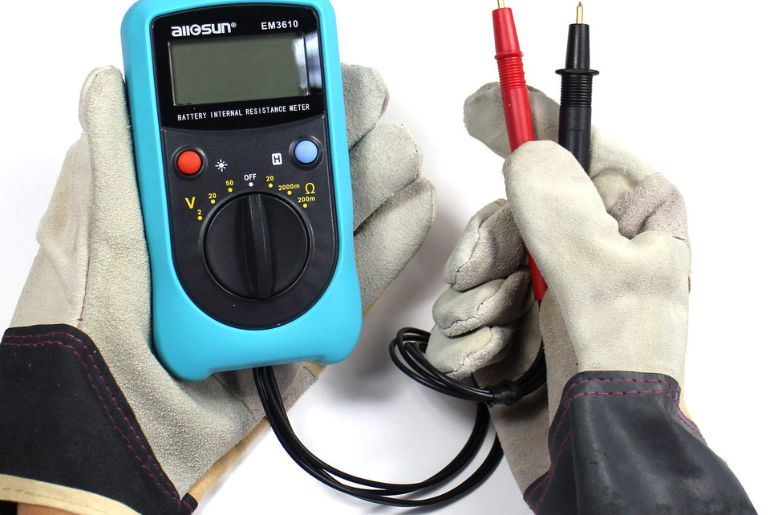
As the increase in the use of high-quality and safety-critical battery cells in areas of e-mobility, energy storage or mobile standardized power tools and many more, battery measuring technology is becoming increasingly important in industrial automation for suppliers, plant, manufacturers and machine builders. And to ensure the safety and assessment of performance and health of lithium-ion batteries, it is important to understand the battery testing parameters. For the assessment we must use the modern parameters as the old paradigm of just measuring voltage, current and time is completely inadequate for modern battery development, validation and diagnostic.
Here are 12 new parameters every modern battery tester must measure:
1. Core Electrical & Temporal Measurement
These are the foundational metrics and critical for all battery types:
- High-Frequency Voltage & Current: Modern testers measure voltage and current very quickly (10,000-100,000 times per second) and keep both readings perfectly in sync. This is important because slow measurements have higher chances to miss fast events and high-speed data is needed for tests like EIS and for calculating real-time power during quick changes, such as regenerative braking in electric vehicles.
- Accurate Temperature Measurement at Multiple Points: Testers are used for measuring temperature at different spots on the battery such as- positive tab, negative tab and the side of the cell. Temperature can affect battery health and safety more than anything else and multi-point monitoring helps detect hot spots and improve thermal management.
- Coulombic Efficiency (CE): It shows how much charge the battery gives in comparison to how much it takes in because a small difference can strongly affect battery life and tracking CE over many cycles helps identify early internal problems.
2. Battery State and Health Parameters
These values tell us how much energy the battery has and battery health:
- State of Charge (SOC): It’s known as the battery’s “fuel level,” shown in percentage. It depends on factors like temperature and aging. Testers help verify how accurate the BMS’S SOC readings are.
- State of Health (SOH): It tells us the age of the battery. It includes capacity loss and increased resistance (power loss). SOH also helps decide when a battery is nearing its end of life.
- Internal Resistance (DCIR & ACIR\EIS): Internal resistance helps check the battery’s power capability and identify deeper electrochemical changes.
Note: DCIR is measured using a small current pulse and checking the voltage change. ACIR OR EIS uses AC signals across different frequencies.
3. Advanced Electrochemical and Dynamic Measurements
It helps us understand what is happening inside the battery at a deeper level. These tests show how the battery’s materials behave, how they age over time and how they respond during real-world charging and discharging conditions.
- Incremental Capacity Analysis (ICA) & Differential Voltage Analysis (DVA): These tests are done using slow charge and discharge cycles. The resulting curves show peaks that match specific reactions inside the battery. As the battery ages, these peaks change, helping us see which part is degrading.
- Relaxation Voltage & Time Constant: After charging and discharging, the battery is at rest, and the voltage gradually settles. This relaxation behaviour shows how ions move inside the battery and can indicate issues like lithium plating.
- Self-discharge rate: It shows how fast a fully charge battery loses it charge without being used. Higher self-discharge rate shows internal problems such as micro-shorts or electrolyte breakdown.
4. Operational & Safety Measurements
It checks how a battery behaves under real-world working conditions and ensures it operates safely. These tests help identify risks like overheating, gas buildup or swelling before thy lead to failure.
- Thermal Runway Temperature: It identifies the exact temperature at which the battery becomes unstable and start to head uncontrollably. It is important for safety and design.
- Gas Evolution: During stress conditions like overcharging, the battery can release gases. Measuring the amount and type of gas helps understand internal reactions and prevent swelling or venting.
- Mechanical strain & Swelling: Batteries expand and contract during each cycle. By measuring this you can detect damage, gas buildup or electrode separation, which is important for pack design.
By measuring these key parameters, engineers can understand not just if a battery is failing, but why it is failing. This helps create safer, longer-lasting and better-performing batteries.
 Electrify your feed!