India’s renewable energy story is often told through megawatts, solar modules, and battery breakthroughs—but the real strength of this transition lies beneath it all. At the foundation of every solar park and storage-integrated grid is a layer of engineered infrastructure that determines reliability, longevity, and performance. This is where Enlight Metals is quietly making a powerful impact. Moving beyond the traditional perception of steel as a basic commodity, the company is positioning itself as a technology-led infrastructure partner—bringing together advanced materials, decentralized manufacturing, and AI-driven supply chain intelligence to solve one of the industry’s most persistent bottlenecks.
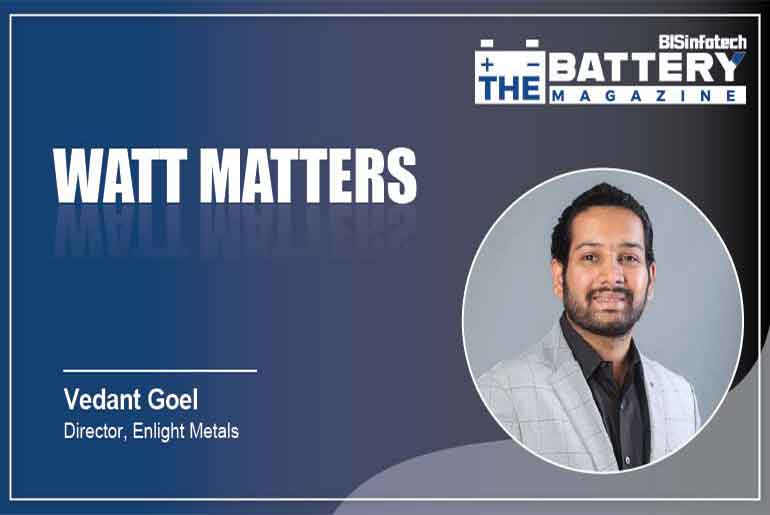
At a time when India is accelerating toward a storage-integrated, round-the-clock renewable ecosystem, Enlight Metals stands at the intersection of strength and strategy. In a thought-provoking discussion, Shweta Kumari, Sub Editor of The Battery Magazine, engaged with Vedant Goel, Director, Enlight Metals to uncover deeper insights into this transformation. Vedant Goel highlights how the evolution of solar infrastructure—from static mounting systems to intelligent, lifecycle-focused engineering—is critical to ensuring project efficiency and long-term asset reliability. From enabling faster project execution to reducing total cost of ownership through high-performance materials, the company is redefining what it means to build for the energy transition.
As the sector grows more complex and demanding, Enlight Metals’ vision of becoming a full-stack infrastructure enabler signals a decisive shift in how solar and storage projects will be built in the years ahead. Read on to explore the insights shaping this transformation.
As India rapidly scales its renewable capacity, how do you see the role of solar infrastructure components like mounting structures evolving in enabling a more reliable and storage-integrated energy ecosystem?
The energy transition is usually talked about in terms of active tech like solar cells and battery chemistry. But as India scales up its renewable targets, the physical infrastructure supporting it all has to evolve just as fast. We are way past the days of looking at mounting structures as just cheap metal racks. Today, they are highly engineered assets. They have to protect expensive modules and battery systems against unpredictable weather and tough terrains.
For a storage-integrated grid, reliability is everything. The grid needs to run around the clock. That means our structures must support heavier bifacial modules while fitting perfectly with local storage systems. It is a complete shift from static metal to smart, lifecycle-focused engineering. The structural integrity of these installations is what actually guarantees the safety and uptime of the entire renewable asset over a 25-year horizon.
Enlight Metals has traditionally been a materials and supply chain player. What strategic thinking led to your entry into solar structure manufacturing, and how does this align with the broader energy transition?
To be clear on our approach, Enlight Metals operates as a technology-led metal aggregator, not a legacy manufacturer. We stepped into localized contract manufacturing because we saw massive inefficiencies in how the energy transition was being handled on the ground. Right now, we are scaling operations across Faridabad, Raipur, and Pune.
We noticed that the real bottleneck in utility-scale solar was not getting the panels. It was the rigid and fragmented supply chain of structural mild steel. Traditional manufacturing ties up too much capital and is limited geographically, which causes huge logistical headaches for developers. By building a decentralized network of contract manufacturers and running it through our proprietary supply chain tech, we bridge the gap between raw material and on-site execution. This gives developers exactly what they need, exactly when they need it, bypassing local delays entirely.
With the increasing integration of BESS (Battery Energy Storage Systems) alongside solar projects, how do mounting structures and balance-of-system components need to evolve to support hybrid solar-plus-storage deployments?
Mixing solar arrays with Battery Energy Storage Systems completely changes the math for a site’s spatial and structural layout. You are no longer just running simple direct current cables. You have to account for heavy battery containers, advanced thermal management, and complex hybrid routing.
Because of this, mounting structures and balance-of-system components have to become incredibly modular. We have to engineer reinforced foundations that can handle the dense weight of battery units while keeping strict fire safety and environmental shielding intact. Cable routing also needs to be built straight into the structural design to make long-term maintenance easier. Our focus is on building a unified, plug-and-play framework that already anticipates the physical footprint of storage. This cuts out messy on-site modifications and speeds up deployment.
You’ve highlighted the use of AI-driven demand forecasting and supply chain optimization. Can you elaborate on how these technologies translate into real on-ground benefits for solar and energy developers?
The biggest hurdles in utility-scale solar are rarely technical. They are almost always logistical and financial. A delay in steel delivery or a sudden price spike can destroy a project’s margins before ground is even broken. That is why we invested so heavily in our data architecture.
We use tools like Azure Databricks and Lakehouse designs to process massive amounts of market data. This lets us predict pricing trends, optimize slitting plans for HR, CR, and GP steel coils, and automate the buying cycle. For the developer, all of this translates into one thing: certainty. We anticipate supply crunches and deliver materials just-in-time. This can shrink project planning timelines by up to 70 percent, meaning developers do not have cash trapped in idle steel sitting in a field. We handle the supply chain chaos so they can focus on building.
Your structures use advanced grades like AZ150, AZ180, and AZ200 Galvalume steel. How critical is material science innovation in improving the lifespan and performance of renewable energy infrastructure?
Material science is really the unsung hero of the renewable sector. Solar panels and batteries come with warranties lasting decades. It makes zero economic sense if the steel skeleton holding them up rusts away before the technology degrades.
We put a massive focus on mild steel treated with advanced Galvalume coatings like AZ150, AZ180, and AZ200. This specific mix of aluminum, zinc, and silicon creates a double layer of armor. The aluminum blocks the elements, and the zinc acts as a sacrificial layer if the steel is ever scratched. In India, projects face everything from salty coastal air to harsh desert sand. These coatings are non-negotiable. They stop micro-cracking during manufacturing and ensure the structure actually outlasts the plant’s operational life.
Using solar-grade steel with yield strengths exceeding 550 MPa is a high-spec choice. How is Enlight Metals balancing the premium cost of these advanced materials with the industry’s constant push for lower LCOE (Levelized Cost of Energy), especially in record-low tariff environments?
It might sound backward that buying premium, 550 MPa yield strength steel actually lowers the Levelized Cost of Energy. But the math works out beautifully. Because this steel is exceptionally strong, our engineers can redesign the structural geometry entirely.
We can use thinner gauges of steel and still hit the exact same load-bearing and wind-resistance targets. This drops the total tonnage of steel needed per megawatt significantly. Less steel means a lower raw material bill, much cheaper freight costs, and faster installation times on site. Winning in a low-tariff environment is not about finding the cheapest, heaviest metal. It is about using highly engineered, weight-efficient systems that save money on both materials and labor.
With a focus on 25+ year lifecycle performance, how do you see high-durability structures contributing to ESG goals and reducing the total cost of ownership for renewable energy assets?
When we talk about sustainability, we have to look at the entire physical footprint of a project, not just the clean power it makes. If you have to manufacture, ship, and replace rusted structural steel ten years into a solar plant’s life, the carbon penalty is huge.
By designing structures to easily last 25 years or more, we are directly supporting a circular economy. This kind of longevity massively reduces the Total Cost of Ownership. It protects developers and investors from the nasty financial surprises of mid-life replacements or structural failures. When the physical bones of a project are permanent, the financial models stay robust and predictable.
Looking ahead, with plans to expand into cable trays and pre-engineered building (PEB) components, do you envision Enlight Metals becoming a full-stack infrastructure partner for solar and storage projects?
Absolutely. Our vision is to be the definitive, full-stack infrastructure partner for the renewable sector. As we grow our agile manufacturing network to include critical components like cable trays and pre-engineered buildings, we want to be the operating system for physical solar deployment.
The industry is moving too fast for developers to juggle dozens of unreliable vendors. We are optimizing our entire model to offer productized services. That means moving away from simply selling steel by the ton and moving toward outcome-based partnerships that guarantee delivery and performance. By combining AI-driven supply chain accuracy with high-grade manufacturing, we are on track for aggressive growth, targeting a revenue milestone of 1200 crore for FY 26-27. We are building the frictionless infrastructure layer that lets developers build India’s biggest energy projects without compromise.
 Electrify your feed! Click here to join our Whatsapp group and to get the latest updates, expert insights, and innovations driving India’s energy storage revolution.