On a warm afternoon in a remote village in India’s desert belt, something unusual happens. A group of homes flicker to life—a fan starts spinning, a water pump begins humming, a silent cooking flame glows blue. But there is no diesel generator rumbling, no LPG cylinders stacked behind the houses, and no coal-fired grid line stretching across the horizon.
Instead, the entire village is powered by a quiet, invisible fuel: green hydrogen.
This is not science fiction anymore.
Across the world—from Namibia to Japan, from Australia to the EU—experimental “hydrogen villages” are proof-testing what it means for a community to produce, store, and consume energy using H₂. And now, India is preparing to join this movement, with states like Ladakh, Gujarat, Karnataka, and Odisha conducting feasibility studies for hydrogen-based microgrids.
As the government pushes ahead under the National Green Hydrogen Mission (NGHM) with an outlay of ₹19,744 crore, the concept of hydrogen villages represents one of its most transformative possibilities.
So what really changes when a village runs on green hydrogen?
What technologies power it?
And most importantly—is India ready for this leap?
Let’s dive in.
The Hydrogen Village: A Simple Idea With Transformative Power
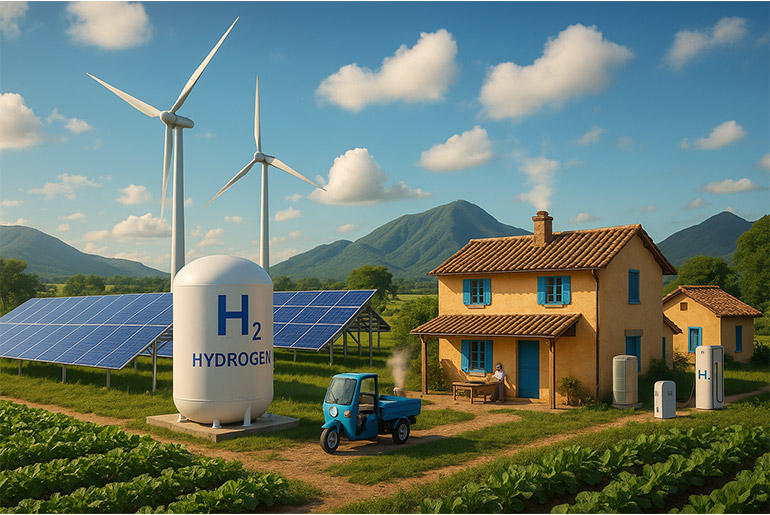
A hydrogen village is a community where green hydrogen—produced from renewable electricity via electrolysis—becomes the backbone of everyday life.
Think of it as a mini, independent hydrogen economy with:
- Solar or wind generators
- Electrolysers
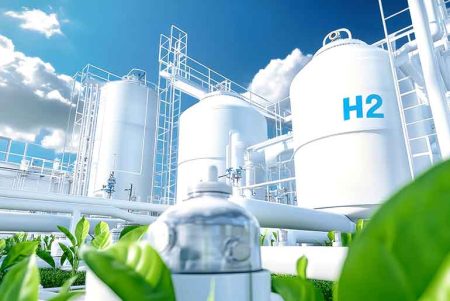
- Hydrogen storage tanks
- Fuel cells or hydrogen burners
Hydrogen-powered cooking, mobility, backup power and industry
In such a village, the sun and wind do not merely generate electricity—they make fuel, enabling round-the-clock clean energy even after sunset.
Why Hydrogen, Not Batteries?
Because hydrogen beats batteries in:
- Long-duration storage (days to months, not hours)
- Seasonal balancing
- Heat applications (cooking, industrial drying)
- Agricultural machinery
Higher energy density for mobility and equipment
A hydrogen village doesn’t replace batteries—it complements them.
While batteries handle short bursts, hydrogen carries the long hours.
How a Green Hydrogen Village Works (Step-by-Step)
Imagine a community of 100–1,000 households in rural India.
Here’s what happens behind the scenes:
1. Solar + Wind → Electricity
- The village uses a 1–5 MW hybrid renewable system, designed for local demand.
2. Electrolyser Splits Water → Hydrogen + Oxygen
- Proven alkaline electrolysers, PEM electrolysers, or upcoming AEM electrolysers break water into green hydrogen.
- India already has manufacturers like Ohmium, Reliance, Adani, Hygenco, Godi, L&T Electrolysers scaling production.
3. Hydrogen Is Stored in Cylinders or Small Tanks
Depending on scale, the village stores H₂ in:
- Compressed cylinders (350 bar or 700 bar)
- Metal hydride tanks
- Underground tanks (in large-scale pilots abroad)
4. Hydrogen Powers Village Needs
Depending on the design, H₂ is used for:
- Electricity generation using fuel cells
- Cooking through hydrogen-ready burners
- Agriculture pumps using H₂ fuel cells
- Backup energy during outages
- Micro-mobility (3-wheelers, tractors)
5. Oxygen is Utilised Too
The by-product oxygen is used for:
- Hospitals
- Water purification
- Local industrial users
- This enhances economic sustainability.
Where in the World Do Hydrogen Villages Exist?
The idea is not theoretical. Several pilots are running globally.
Europe
- Netherlands (Hoogkerk, Groningen): First “hydrogen homes” project using dedicated H₂ pipelines.
- UK (Redcar Hydrogen Village): Homes configured to run entirely on hydrogen boilers.
- Germany (Wuppertal): Hydrogen buses supported by local green-hydrogen production.
Asia-Pacific
- Japan: 100+ hydrogen microgrids and hydrogen-ready homes.
- South Korea: Hydrogen-powered towns being developed under the Hydrogen Economy Roadmap 2040.
- Australia (Denham Hydrogen Demonstration Facility): Hydrogen microgrid powering homes in Western Australia.
Africa & Middle East
- Namibia: Green hydrogen villages under Hyphen Hydrogen project.
- UAE & Saudi Arabia: Hydrogen-ready smart city modules.
India’s First Steps
While the first official hydrogen village is yet to be announced, India has:
- Ladakh Hydrogen Microgrid Project (13.75 MW renewable hybrid): Being developed by NTPC.
- Hygenco Green Hydrogen Villages for Industrial Estates: In Haryana and Rajasthan.
- Gujarat Renewable Hydrogen Corridor: State exploring decentralised hydrogen clusters.
- Odisha’s hydrogen-ready industrial zones.
The model is coming. The groundwork has begun.
How Life Changes in a Hydrogen Village
1. Zero Diesel Dependence
- No more rural diesel pumps or generator noise.
- A hydrogen village runs quietly and cleanly.
2. Reliable 24/7 Power
- Hydrogen storage ensures night-time power, overcoming solar intermittency.
3. Clean Cooking Revolution
Hydrogen stoves provide:
- Smokeless cooking
- Lower indoor pollution
- Reduced LPG dependence
- Countries like Japan have already tested 100% hydrogen cooktops.
4. Hydrogen Mobility
Hydrogen-powered:
- 3-wheelers
- Mini trucks
- Agricultural tractors
- Water pumps
- Fuel cells offer longer run-time than batteries—critical in rural India.
5. Micro-Industry Transformation
Villages can host:
- Cold storage
- Agro-processing mills
- Drying units
- Water-treatment plants
all powered by zero-carbon hydrogen.
6. Employment in New Sectors
Hydrogen villages require:
- Electrolyser technicians
- Fuel-cell maintenance teams
- Storage safety supervisors
- Renewable plant operators
Skills that can uplift rural economies.
The Economics: Can Hydrogen Villages Be Viable?
Current industry estimates place green hydrogen costs in India at roughly ₹250–₹350/kg, depending on renewable tariffs and electrolyser costs.
Industry projections aligned with NGHM’s cost-reduction goals suggest green hydrogen could fall to around ₹100–₹150/kg by 2030 if large-scale manufacturing and renewable integration progress as planned.
A hydrogen village becomes viable when:
- Renewable electricity cost drops to ₹2–2.5/kWh
- Electrolyser CAPEX falls from today’s $700/kW to $200/kW
- Storage systems scale
- Fuel cells become mass-produced in India
With the Global South’s largest electrolyser manufacturing expansion coming from India, costs are expected to fall sharply.
Government Push
The NGHM offers support for:
- Electrolyser manufacturing
- Green hydrogen hubs
- Pilot projects
- R&D
- Storage infrastructure
States like Gujarat, Karnataka, Tamil Nadu and Odisha have already launched hydrogen manufacturing or pilot incentives.
Challenges India Must Solve Before Scaling Hydrogen Villages
1. Water Availability
- Electrolysis requires purified water—about 9 litres per kg of hydrogen.
- Villages must pair hydrogen production with:
- RO systems
- Wastewater treatment
- Atmospheric water generators (pilot stage)
2. Safety Protocols
Hydrogen disperses quickly but requires strict safety rules:
- No open flames
- Ventilation standards
- Sensor networks
- Certified storage zones
- Japan and EU safety codes can guide Indian regulations.
3. High Initial Capex
- Electrolysers and fuel cells are still expensive.
- Community models and state subsidies will be key.
4. Skilled Workforce Shortage
- Hydrogen handling is technical.
- Skill-development centres will be essential.
5. Grid Integration Rules
Green hydrogen microgrids need regulatory clarity on:
- Wheeling
- Banking
- Carbon credits
- Interconnection
RERC, KERC, and CERC are already exploring frameworks.
Why Hydrogen Villages Make India a Global Pioneer
Unlike Western nations where hydrogen is used for heating, India can build villages around:
- Agriculture
- Rural industry
- Transport
- Cooking
- Seasonal storage
Our diverse needs make India the perfect test bed.
A hydrogen village becomes:
- A climate solution
- A rural development strategy
- A technology showcase
- A global export model
It positions India not just as a user, but as an architect of the hydrogen world.
The Future: What a Fully Hydrogen-Powered India Could Look Like
Picture this:
- Green hydrogen tractors ploughing fields
- Community microgrids storing week-long energy
- Hydrogen-powered mini industries creating rural jobs
- No diesel, no LPG, no outages
- Villages becoming net energy producers
Hydrogen villages could someday evolve into hydrogen districts, then hydrogen cities, and eventually hydrogen corridors connecting the countryside to industrial clusters.
Conclusion: The First Hydrogen Village Will Change Everything
Green hydrogen villages offer India a rare opportunity:
- Not just to decarbonise.
- Not just to electrify.
But to reimagine rural life with clean, quiet, reliable, locally produced energy.
The first 3–5 pilot villages will serve as India’s blueprint for scaling hydrogen across thousands of communities. And when that happens, India won’t just follow the hydrogen transition—it will lead it.
This is the future where every sunrise generates tomorrow’s fuel, and every village becomes an energy powerhouse.
A future powered not by scarcity, but by possibility.
 Electrify your feed! Click here to join our Whatsapp group and to get the latest updates, expert insights, and innovations driving India’s energy storage revolution.