Walk into any major renewable energy conference in India today and you will hear plenty of conversations about battery storage. Not just about battery chemistry or cell manufacturing and not even electric vehicles. The conversation has quietly shifted to something much bigger: who will build India’s storage infrastructure, and who will win the tenders that make it possible? For years, India’s clean energy story revolved around adding more renewable generation. Solar parks expanded across Rajasthan. Wind farms stretched across Tamil Nadu and Gujarat. New capacity announcements became almost routine. But somewhere along the way, a new challenge emerged. Generating renewable energy was no longer suffiecient. The real challenge became storing it. Because solar power is most abundant when the sun shines. Demand, however, often peaks after sunset. Wind generation fluctuates. Grid conditions change by the hour. Renewable energy may be clean, but it is not always available exactly when consumers need it. And that is why BESS Tender Opportunities in India have suddenly become one of the most important conversations in the energy sector.
What many people still view as a niche technology has rapidly evolved into a strategic national priority. Battery Energy Storage Systems (BESS) are becoming the backbone of renewable integration, peak power management, grid stability, and energy security. The numbers tell an extraordinary story.
In addition, the latest reports show India’s stationary energy storage marketplace grew from 122,000 MWh to 224,000 MWh over the course of less than 1 calendar year (thus accounting for a volume of 100,000 MWh added). Around 60 GWh is already under execution, approximately 80 GWh remains under tendering, and nearly 35 GWh has already been awarded.
Those are not pilot project numbers. Those are infrastructure numbers. And behind every gigawatt-hour of storage lies something surprisingly simple.
Every storage project begins there. Every bid submission creates opportunities for developers, utilities, investors, EPC contractors, technology providers, and manufacturers. Whether it is the Leading BESS Manufacturers in India supplying advanced battery systems or the BESS EPC Companies in India responsible for engineering and execution, the tender ecosystem has become the marketplace where India’s storage future is being decided.
In many ways, the next phase of India’s energy transition will not be built in factories or boardrooms. It will be built through tenders.
Why Storage Has Suddenly Become India’s Biggest Energy Priority
Let’s start with a simple question.
Why is everyone suddenly talking about storage?
After all, India has spent years building renewable energy capacity. Solar and wind installations continue to break records. So why isn’t that enough? The answer lies in a challenge that every grid operator understands. Renewable energy does not always arrive when it is needed most. Imagine filling a water tank all afternoon but having the highest water demand late at night. Unless you can store that water, a significant portion of the supply loses value.
Electricity works in much the same way. Solar generation peaks during the day. Electricity demand often peaks in the evening. Without storage, the grid must constantly balance these mismatches. As renewable penetration rises, that balancing act becomes increasingly difficult.
This is exactly why storage has moved from being a “good-to-have” technology to a “must-have” infrastructure asset.
According to projections from the Central Electricity Authority (CEA), India’s storage requirement is expected to increase from approximately 82 GWh by 2026-27 to more than 411 GWh by 2031-32. Of this, more than 236 GWh is expected to come from Battery Energy Storage Systems.
Think about what that means. India is not preparing for a few isolated storage projects. It is preparing for an entirely new industry.
And that is precisely why BESS Tender Opportunities in India are expanding at a pace that few expected even three years ago.
BESS Tender Opportunities in India: The Market Has Officially Entered Scale Mode
There is a phrase frequently used by industry veterans:
“The market has crossed the pilot phase.” If there is one sentence that captures India’s storage sector today, this might be it. A few years ago, storage projects were largely demonstrations. Developers, policymakers, and utilities were testing technologies, evaluating business models, and learning how batteries could support the grid. Today, the conversation is completely different. The industry is no longer asking whether storage works. The industry is asking how quickly it can be deployed.
Recent industry data shows that 69 BESS tenders totaling approximately 102 GWh were issued during 2025 alone. To put that into perspective, that single year nearly matched the cumulative tender activity of several previous years combined.
The scale has changed dramatically. More importantly, the nature of the opportunities has changed as well.
Today’s BESS Tender Opportunities in India are no longer limited to standalone storage projects. Developers are seeing opportunities across multiple procurement structures, each designed to solve a different grid challenge.
This diversification is one of the strongest indicators that storage is becoming mainstream. When a market begins creating multiple business models around a technology, it is usually a sign that adoption is accelerating. And that is exactly what we are witnessing today.
A Tour Through India’s Hottest Storage Markets
If you want to understand where the biggest opportunities are emerging, it helps to take a quick tour across India’s energy landscape.
Let’s begin with Gujarat. Few states have embraced storage as aggressively.
With 30 GWh of storage outlay as an aid to financially provide ₹18 lakh per MWh (or equivalent ‘VGF’), thus assisting in closing the technological feasibility gap and the commercial/operational site-producing efficiency gap and chief uses are the ability to reduce developer project risk, the ability to increase utility affordability, and the ability to provide non-utility investors confidence in the development process and in overall storage project funding.
Then there is Rajasthan. For years, Rajasthan’s identity was tied to solar power.
Today, it is increasingly becoming a storage story as well. As some of India’s largest renewable parks continue to expand, storage is becoming essential for managing power flows and supporting grid stability. Large-scale BESS projects are no longer viewed as optional infrastructure. They are becoming part of the core project architecture.
West Bengal is another market quietly attracting attention.
State-level utilities are beginning to recognize the value of storage in improving reliability and reducing grid stress. Thus, for developers looking for new opportunities beyond established renewable sources, this is an area worth watching. Further, Telangana has begun to take steps along this same path to improve the grid because of/through the increasing amount of electricity demand and renewable penetration being used for generation. Therefore, these instances are representative of a broader trend in the industry. Storage is no longer being driven solely by central agencies. States are becoming active participants.
And that means the pipeline of BESS Tender Opportunities in India is becoming deeper, broader, and far more geographically diverse than ever before.
Not All BESS Tenders Are Created Equal
One of the biggest mistakes newcomers make is assuming every storage tender looks the same. In reality, the market has evolved into several distinct procurement models.
Understanding these models can often determine whether a developer pursues the right opportunity—or wastes months chasing the wrong one.
Let’s start with the most straightforward structure.
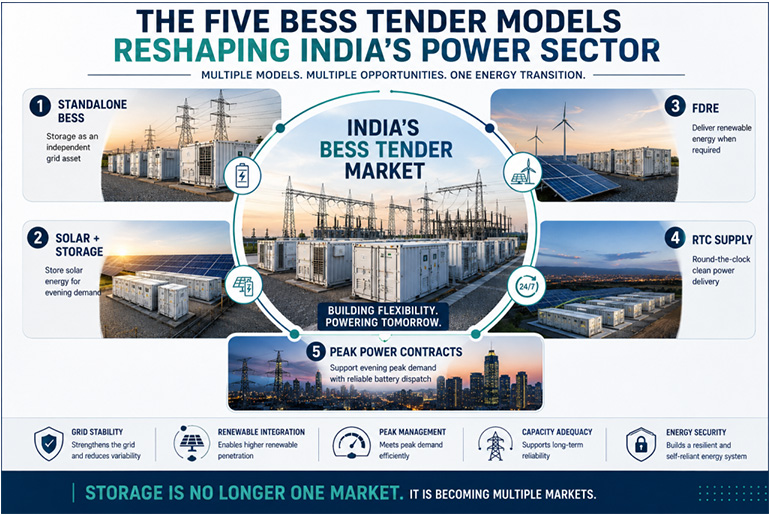
Standalone BESS
This is pure storage. No solar plant. No wind project. Just a battery system providing flexibility, reliability, and grid support. Many utilities increasingly favor standalone BESS because it allows them to strengthen the grid without being tied to a specific generation asset.
Then comes one of the fastest-growing categories.
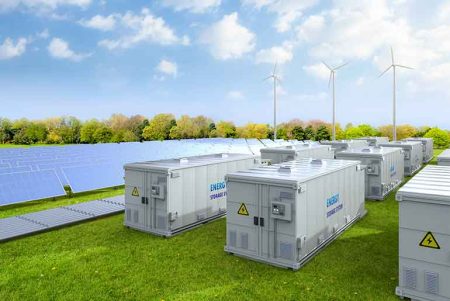
Solar Plus Storage
This model combines renewable generation with battery storage. During the day, excess solar energy charges the battery. Later, when demand rises or solar generation falls, that stored energy is dispatched back to the grid. For many developers, this has become the natural evolution of utility-scale solar. And then things get even more interesting.
FDRE: The New Benchmark
Firm and Dispatchable Renewable Energy (FDRE) tenders are rapidly emerging as one of the most sophisticated opportunities in the market. The concept is simple. Generating renewable electricity is no longer enough. Developers must also ensure that power can be delivered when required. That requires storage. And lots of it. Many industry experts believe FDRE could become one of the defining procurement models of the next decade. Because ultimately, grids do not care when renewable energy is generated.
They care when it can be delivered. For that reason alone, FDRE is likely to remain one of the most exciting segments within BESS Tender Opportunities in India.
What Actually Wins a BESS Tender?
Let’s be honest. Most people assume BESS tenders are won by whoever quotes the lowest price. On paper, that sounds logical. In reality, that is only part of the story.
As storage projects become larger and more important to grid operations, utilities are looking far beyond tariff numbers. A bid may look attractive financially, but if the technology, execution capability, or long-term reliability appears weak, the chances of success diminish quickly.
This is why modern storage tenders have become far more sophisticated.
Today’s projects often come with operational commitments stretching 10 to 15 years. Many require system lifetimes of 20 to 25 years. Availability guarantees, efficiency commitments, safety requirements, and performance obligations are now becoming just as important as price.
In other words, developers are no longer selling batteries. They are selling confidence. Confidence that the system will still perform a decade from now. Confidence that the project will remain safe under extreme conditions. Confidence that the asset can continue supporting the grid long after commissioning. This is where the ecosystem we have explored throughout this content series starts coming together.
Winning storage projects increasingly depends on partnerships with the Leading BESS Manufacturers in India, experienced BESS EPC Companies in India, reliable system integrators, advanced thermal management providers, and trusted technology suppliers.
The days of winning purely on price are slowly fading. The future belongs to those who can deliver performance.
Why VGF Changed Everything
If there is one reason why BESS Tender Opportunities in India seem to be appearing everywhere today, it is Viability Gap Funding (VGF). For years, the industry faced a frustrating reality. Everyone knew storage would become essential. Everyone agreed batteries would eventually become part of the grid. But the economics did not always make sense. Utilities wanted storage. Developers wanted projects. Investors wanted returns. Yet costs remained a challenge.
Then came the government’s ₹5,400 crore VGF support program. Almost overnight, the conversation changed.
The VGF initiative supported 30 GWh of storage deployment by providing funds for storage projects of ₹18 lakh per MWh. This assistance helped to close the gap between the technological need for storage and the commercial viability of storage projects. In addition, the VGF reduced project risks for developers, increased affordability for utilities, and improved investor confidence. And for the broader industry, it accelerated momentum.
The result?
Storage procurement is no longer viewed as a future requirement. It is becoming a present-day priority. Many of the most attractive BESS Tender Opportunities in India today are directly linked to this changing economic landscape. Simply put, VGF has done for storage what policy support once did for solar. It helped move the industry from ambition to execution.
Safety Is No Longer a Technical Discussion
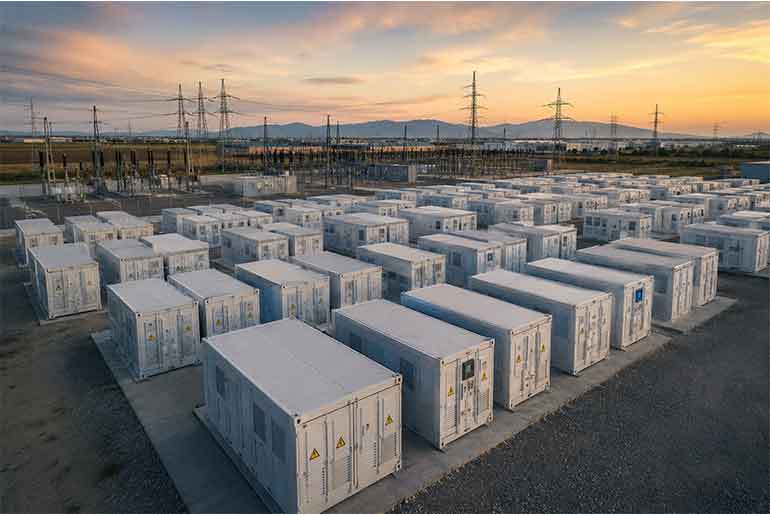
A few years ago, safety was often treated as an engineering conversation. Today, it has become a business conversation. And there is a very good reason for that. The size of projects is increasing rapidly. What was once a 20 MWh project has become a 200 MWh project.
What was once a few containers has become an entire storage facility. As project sizes grow, so do the consequences of failure. That is why modern tenders are placing unprecedented emphasis on safety and compliance.
Today’s projects increasingly require:
- Advanced Battery Management Systems (BMS)
- Thermal runaway detection
- Automated shutdown mechanisms
- Fire suppression systems
- Multi-level monitoring
- Emergency response protocols
This is also why Thermal Management Systems for BESS have become one of the most important aspects of project design.
As we discussed in our previous article, thermal management is no longer simply about keeping batteries cool. It is about protecting the entire asset.
A well-designed thermal management system helps maintain performance, extend battery life, reduce degradation, improve safety, and prevent thermal runaway events. For developers pursuing BESS Tender Opportunities in India, thermal engineering is becoming a competitive advantage. The same evolution can be seen in storage containers.
A modern Battery Container Manufacturer in India is no longer building a simple steel enclosure.
Today’s battery containers are sophisticated engineering environments equipped with insulation systems, fire protection mechanisms, sensors, thermal controls, and intelligent monitoring technologies.
In many ways, the container has become a safety system in its own right.
The Hidden Role of PCS Technology
Here’s something many people outside the industry don’t realize. A battery does not communicate directly with the grid. Something else sits in between. The Power Conversion System. And its importance continues to grow.
A modern PCS Supplier for BESS in India is responsible for helping batteries charge efficiently, discharge effectively, respond rapidly to grid signals, and maintain system stability.
Think of the PCS as the translator between two worlds. On one side sits the battery storing DC power. On the other side sits the grid operating in AC. The PCS makes that conversation possible. But it does much more than simply convert electricity. It influences efficiency. It influences response times. It influences thermal performance. It influences project economics.
As a result, PCS selection is increasingly becoming a strategic decision rather than a procurement exercise. Many developers now spend significant time evaluating PCS partners long before a tender is even released. Because in today’s market, technology choices can determine bid competitiveness.
What Smart Developers Do Before the Tender Even Arrives
One of the biggest misconceptions in the industry is that tender preparation starts when the tender document is published.
The smartest developers know otherwise. Preparation often begins months earlier. Sometimes years. They monitor policy developments. They track utility procurement plans. They build relationships with suppliers. They evaluate technologies. They secure financing channels. By the time the tender arrives, much of the groundwork has already been completed.
Let’s take a simple example. Imagine a developer pursuing a large standalone BESS project. Before the bid is submitted, several critical questions must already have answers.
- Which battery supplier will be used?
- Which PCS technology will be selected?
- What thermal management strategy will be adopted?
- Who will execute the EPC work?
- What financing structure will support the project?
- How will performance guarantees be met?
Every one of these decisions influences competitiveness. And every one of them can affect project profitability for years after commissioning.
This is precisely why successful bidders increasingly operate as ecosystem builders rather than project developers alone.
The Biggest Risks Nobody Talks About
The opportunities are enormous. But so are the challenges. One risk is supply-chain volatility. Battery prices have fallen significantly, but raw material markets remain unpredictable. Changes in lithium, nickel, or graphite prices can influence project economics.
Another challenge is execution. Winning a tender is one thing. Delivering a project on schedule is another. Land acquisition delays, transmission constraints, regulatory approvals, logistics challenges, and commissioning hurdles can all impact project timelines.
There is also the issue of performance accountability. Modern storage projects come with strict efficiency, availability, and operational commitments. Missing those targets can lead to penalties and financial consequences. This is why experienced developers spend just as much time managing risk as they do pursuing opportunity. Because in the storage industry, successful execution often matters more than successful bidding.
Where Are the Next BESS Tender Opportunities in India Emerging?
The most exciting part of the story may still lie ahead. Today, most storage tenders focus on renewable integration and grid balancing. Tomorrow’s opportunities could be much broader.
Storage is expected to play a growing role in:
- Firm and Dispatchable Renewable Energy projects
- Round-the-Clock renewable supply
- Ancillary services markets
- Data centers
- Industrial power management
- Green hydrogen projects
- Peak demand management
- Capacity markets
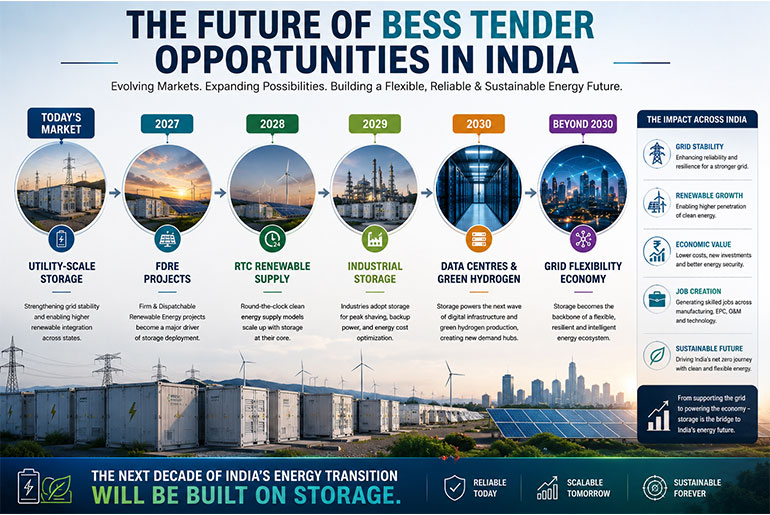
This means the future of BESS Tender Opportunities in India will extend far beyond traditional utility procurement. Storage will increasingly become a critical infrastructure asset across multiple sectors. The market is moving from “storage for renewables” to “storage for the entire economy.” And that is a much bigger opportunity.
The Tender Era Has Arrived
Every energy transition has a defining moment. For solar, it was the rise of utility-scale procurement. For electric vehicles, it was the emergence of large-scale manufacturing. For energy storage, that defining moment is happening right now.
The rise of BESS Tender Opportunities in India is creating an entirely new market ecosystem—one that connects developers, manufacturers, EPC companies, technology providers, financiers, and policymakers.
The story is no longer simply about batteries. It is about building flexibility into India’s energy future. It is about ensuring renewable energy is available when the grid needs it most. It is about transforming storage from a supporting technology into a critical national infrastructure asset. And perhaps most importantly, it is about recognizing that every major storage project begins with a tender.
The companies that understand this shift early—whether they are among the Leading BESS Manufacturers in India, experienced BESS EPC Companies in India, advanced PCS Suppliers for BESS in India, or specialists in Thermal Management Systems for BESS—will be best positioned to benefit from the next chapter of India’s energy transition.
Because the future of India’s power sector may not be decided by who generates the most electricity.
It may be decided by who can store it, manage it, and deliver it precisely when the country needs it most.
 Electrify your feed! Click here to join our Whatsapp group and to get the latest updates, expert insights, and innovations driving India’s energy storage revolution.