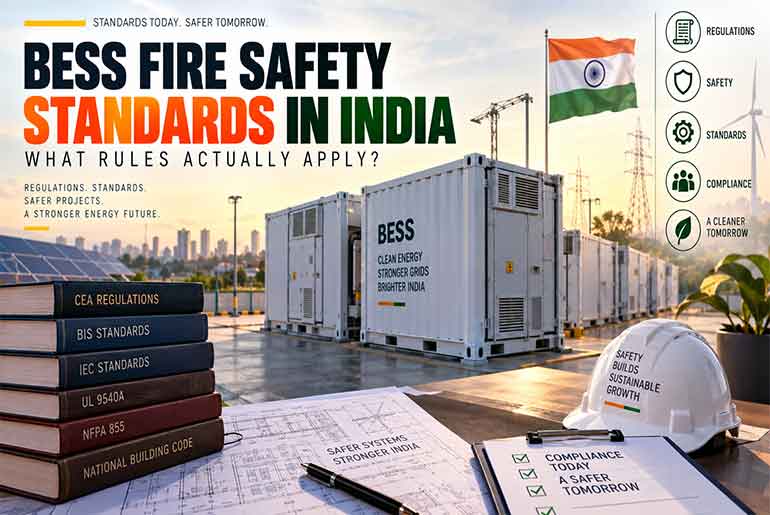
India’s Battery Energy Storage System market has moved faster than its safety rulebook. That is changing. For years, developers, EPC companies and battery manufacturers have had to navigate a mixture of electrical-safety regulations, Indian Standards, international standards, project specifications and fire-safety practices. There was no single document that could simply be opened and treated as the complete rulebook for utility-scale BESS Fire safety.
In March 2026, however, the Central Electricity Authority took a significant step forward by notifying the Central Electricity Authority (Measures relating to Safety and Electric Supply) Amendment Regulations, 2026. The amendment inserts a dedicated Chapter XA — Additional Safety Requirements for Battery Energy Storage System, covering issues ranging from two-fault tolerance and battery-management systems to explosion protection, ventilation, hazard detection, fire suppression and independent fire-safety audits. The provisions come into force on 1 April 2027.
But there is an important catch.
The new regulation itself repeatedly refers to “relevant standards”, while a new Regulation 137 provides that CEA will issue a separate list of those relevant standards within three months of the regulations coming into force. That means India’s BESS safety architecture is becoming clearer, but the complete compliance map is still being assembled.
So, when the industry asks about BESS Fire Safety Standards in India, the answer cannot simply be “CEA 2026.”
It is a layered system.
And understanding which layer does what is becoming essential.
What Are BESS Fire Safety Standards in India Actually?
The phrase BESS Fire Safety Standards in India covers several different kinds of requirements that should not be treated as interchangeable.
There are:
- CEA regulations, which establish legally binding safety requirements within their scope;
- Bureau of Indian Standards (BIS) standards, which establish Indian technical standards;
- IEC standards adopted as Indian Standards, where BIS has adopted them;
- international standards and testing methodologies, such as UL 9540A and NFPA documents, which may be
- referenced in project specifications or used as technical benchmarks;
- building and fire-safety requirements, depending on the project and jurisdiction; and
- project-specific engineering specifications and fire-safety requirements.
This distinction matters because a standard being widely used internationally does not automatically mean it is an Indian statutory requirement.
Similarly, a draft CEA proposal should not be described as a rule that developers are already legally required to follow.
That distinction has become particularly important after the 2026 CEA amendment.
The Biggest Development: CEA’s Dedicated BESS Safety Chapter
The Central Electricity Authority notified the 2026 amendment on 27 March 2026.
The amendment inserts Chapter XA — Additional Safety Requirements for Battery Energy Storage System into the CEA’s 2023 safety regulations.
The new chapter applies in addition to the existing safety requirements in Chapters I to VII and XIV of the 2023 regulations. It defines BESS as a stationary system connected to the electricity system that stores electrical energy using electrochemical materials and typically includes batteries, a power-conversion system and a battery-management system.
The provisions take effect on:
1 April 2027
That date is important for every BESS developer currently designing, procuring or constructing projects against a future operating life.
The CEA framework is not simply a fire-code amendment.
It creates requirements across the complete BESS safety chain.
What Does the 2026 CEA Regulation Actually Require?
The new Chapter XA is divided into several sections.
122(A) — Additional safety requirements
The BESS-specific chapter operates in addition to the existing CEA safety regulations.
That means developers should not read the new BESS chapter as replacing the broader electrical-safety framework.
It adds another layer.
122(B) — General Safety Considerations
One of the most important requirements is two-fault tolerance.
The regulation says BESS should be designed with two-fault tolerance to prevent catastrophic failures under conditions including:
- overcharge;
- over-discharge;
- short circuit; and
- operation outside specified temperature limits.
CEA explains two-fault tolerance as the ability of the system to continue operating safely or shut down safely even after two independent faults have occurred.
This is a significant shift in the safety philosophy.
The question is no longer simply:
“What happens if one component fails?”
It is:
“Can the system remain safe when more than one independent fault occurs?”
The regulation also requires BESS testing according to relevant standards and requires fire and explosion protection at the cell, module, container and site-specific installation levels, according to relevant standards.
That last point is particularly important.
It establishes the principle that BESS fire safety cannot be demonstrated only at cell level.
BESS Containers Now Have Specific Safety Requirements
The CEA framework separately addresses battery containers.
For applicable BESS installations, the container must have:
- explosion protection;
- forced ventilation;
- automated louvers for safe release of flammable gases;
- measures to maintain internal pressure within safe limits;
- ingress protection according to relevant standards; and
- appropriate access arrangements for walk-in units.
This is where BESS Fire Safety Standards in India become very different from conventional electrical-equipment safety.
A BESS container is not simply a box containing batteries.
The enclosure itself becomes part of the safety system.
It has to manage:
heat + gases + pressure + fire + access + electrical hazards.
That is why container-level engineering is becoming increasingly important.
Ventilation Is Now Part of BESS Safety
The 2026 CEA framework also specifically addresses HVAC, cooling and ventilation.
BESS HVAC and cooling systems must be installed for proper thermal management according to relevant standards.
The regulations also require a mechanism to limit the concentration of flammable materials inside the BESS enclosure.
And if mechanical ventilation fails, the system must initiate shutdown to maintain flammable-material concentration within safe limits.
This connects directly with the previous article in our series on BESS Explosion Risk.
A battery can release flammable gases during a severe thermal event.
Therefore:
- Detection without ventilation is incomplete.
- Ventilation without shutdown logic is incomplete.
And:
- Fire suppression without gas management is incomplete.
The regulatory architecture is beginning to recognise that these hazards are connected.
Hazard Detection: Smoke Is No Longer Enough
The CEA framework specifically requires hazard-detection systems covering:
- smoke;
- gas;
- heat; and
- flame.
The systems must also be monitored.
This is an important development because it recognises that a BESS incident can present different warning signals at different stages.
- A battery may generate gas before visible flames.
- Temperature can rise before smoke becomes obvious.
- Flame detection belongs at a later stage.
- BMS monitoring may provide another stream of information.
A layered detection strategy therefore becomes central to BESS Fire Safety Standards in India.
This aligns closely with the broader direction of international BESS safety engineering, where early warning, thermal-runaway detection and fire detection are increasingly treated as interconnected rather than identical functions.
Automatic Fire Suppression Is Now Explicitly Required
The final CEA regulation requires every battery container covered by the provision to have an automatic fire-suppression system according to the relevant standard.
And this is where we need to make a very important editorial distinction.
The 2025 draft and the 2026 final regulation are not identical.
The 2025 draft had proposed that every battery container rated 200 kWh and above have a water-based automatic fire-suppression system.
That wording appeared in the draft published by CEA.
But the final 2026 regulation changed the provision.
It requires automatic fire suppression for every applicable battery container according to the relevant standard, without prescribing water as the universal suppression medium in that clause.
That difference is important for anyone writing or reading about BESS Fire Safety Standards in India.
The 200 kWh water-based requirement belongs to the draft, not the final notified rule.
Fire Safety Is Now Linked to Emergency Shutdown
The 2026 amendment also addresses emergency stops.
If a safety issue or battery anomaly is detected, the affected BESS section must shut down within a preset period.
Manual emergency-stop buttons, switches or mechanisms must also be placed at accessible and visible locations.
This creates a useful safety chain:
Detect → Alarm → Isolate → Shut down → Suppress/Contain → Respond
It is another indication that the CEA framework is approaching BESS safety as a system architecture, rather than a collection of independent fire-protection devices.
What About Equipment Separation?
The regulations also require minimum space separation between adjacent BESS enclosures and between BESS enclosures and the nearest building, with requirements linked to battery chemistry and relevant standards.
This matters because thermal runaway is not only a battery problem.
It is also a propagation problem.
A container that experiences a serious thermal event can potentially expose nearby equipment to:
- heat;
- flames;
- gases;
- radiant energy;
- pressure effects.
Physical separation provides another layer of protection.
The exact separation distances, however, need to be determined through the applicable standards and engineering requirements rather than assuming one universal number for every chemistry and installation.
What About Fire-Safety Audits?
This is another major addition.
The final CEA regulations provide for an independent third-party fire-safety audit of BESS installations.
The owner is required to submit the fire-safety audit report to the Electrical Inspector at the time of inspection.
CEA had already moved toward this approach before the final regulations.
In December 2025, the authority published a draft SOP inviting public comments on an Independent Third-Party Fire Safety Audit of Battery Energy Storage System (BESS).
This is significant because it changes the conversation from:
“Does the project have the required equipment?”
to:
“Can an independent party verify that the safety system actually meets the required framework?”
That will become the subject of the next article in our cluster on BESS Fire Safety Audit.
India Is Also Training Fire-Safety Officials for BESS
The regulatory framework recognises that having standards is not enough.
Fire responders need to understand the technology.
CEA published Guidelines for Training of Fire Safety Officials under the 2026 BESS amendment on 4 September 2026. The CEA page identifies the guidelines specifically for BESS installations.
This is a notable development because BESS emergencies can involve hazards that are different from conventional fires:
- thermal runaway;
- stored electrical energy;
- toxic gases;
- flammable gases;
- re-ignition;
- damaged but still hazardous cells;
- container pressure;
- and post-fire battery handling.
Training therefore becomes part of the safety framework rather than an afterthought.
What Happens to BESS Installations Below 650 V?
This is one of the areas where readers need to be especially careful.
The CEA’s 2026 framework states that the detailed Chapter XA provisions from 122(A) through 122(M) apply to BESS installations connected at a voltage level exceeding 650 V.
For BESS installations connected at 650 V and below, Regulation 122(N) says they shall comply with the relevant standards.
That should not be interpreted as meaning lower-voltage BESS are simply outside safety regulation.
They remain subject to the applicable safety framework and relevant standards.
The difference is that the detailed prescriptive Chapter XA provisions are framed differently according to the voltage threshold.
This distinction will matter particularly as C&I and distributed storage grows alongside utility-scale BESS.
So, Which Indian Standards Apply?
This is where the answer becomes more nuanced.
BIS already has a dedicated standards programme for Electrical Energy Storage Systems, under committee ETD 52.
The current BIS programme lists nine published standards and ten standards under development.
Among the published standards relevant to electrical energy storage are:
IS 17067 (Part 5/Sec 2):2021
Based on IEC TS 62933-5-2, covering safety requirements for grid-integrated electrical energy storage systems using electrochemical systems.
This is particularly relevant to BESS because it addresses system-level safety.
IS 17092:2019
Electrical energy storage systems — safety requirements.
BIS currently lists this as an Indian Standard within its EES standards programme.
IS 17067 (Part 2/Sec 1):2019
Based on IEC 62933-2-1 and covering unit parameters and testing methods for electrical energy-storage systems.
IS 17067 (Part 2/Sec 2):2025
Based on IEC 62933-2-2 and covering application and performance testing.
IS 17387:2020
General Safety and Performance Requirements of Battery Management Systems.
This is particularly relevant because BMS performance sits at the heart of battery protection.
IS 19143 (Part 4/Sec 4):2025
Based on IEC 62933-4-4 and addressing environmental requirements for battery-based energy storage systems using reused batteries.
This becomes increasingly relevant as second-life and reused-battery applications develop.
Is UL 9540 Mandatory in India?
This is exactly where articles about BESS Fire Safety Standards in India can become misleading.
UL 9540 is an important international BESS safety standard.
UL 9540A is a test method used to evaluate thermal-runaway fire propagation and related fire/explosion behaviour.
They are highly relevant to international BESS procurement and project design.
But we should not casually write that UL 9540 or UL 9540A is universally mandatory under Indian law.
The 2026 CEA regulation does not simply say:
“Every BESS must have UL 9540A certification.”
Instead, the regulation repeatedly refers to relevant standards and provides for CEA to issue a list of relevant standards through Regulation 137.
That distinction is essential.
A project tender, lender, insurer, EPC contract or technical specification may separately require UL testing or certification.
That is different from saying the standard is universally mandated by Indian law.
What About NFPA 855?
NFPA 855 is another major international reference for stationary energy-storage installation safety.
It addresses areas such as:
- installation;
- fire protection;
- separation;
- ventilation;
- emergency planning;
- explosion control;
- commissioning and maintenance considerations.
But again, NFPA 855 should not automatically be described as an Indian statutory requirement.
Its relevance depends on the applicable project requirements, specifications, standards adopted by authorities and the contractual or engineering framework governing the installation.
This distinction is especially important for BESS developers working with international investors and equipment suppliers.
A project may voluntarily or contractually adopt a more stringent international standard even where a particular provision is not itself an Indian statutory requirement.
What About the National Building Code?
The National Building Code of India remains an important reference for building and fire-safety considerations where its provisions apply to the project.
But a utility-scale outdoor containerised BESS cannot be reduced to a conventional building-fire-code problem.
The battery system introduces additional technical hazards involving:
- thermal runaway;
- stored electrical energy;
- battery gases;
- ventilation;
- explosion protection;
- electrical isolation;
- emergency shutdown.
Therefore, NBC provisions may form part of the overall compliance landscape, but they do not replace BESS-specific technical requirements.
This is precisely why the CEA’s 2026 amendment is significant.
It creates a dedicated BESS safety chapter rather than leaving the industry to interpret generic electrical and building provisions alone.
India’s Standards Ecosystem Is Still Being Built
This is perhaps the most important finding for the article.
India has made significant progress.
But the standards ecosystem is not finished.
BIS’s current ETD 52 programme shows both published standards and a substantial pipeline of standards under development. The programme currently lists nine published standards and ten under development.
The list includes finalized draft standards covering:
- EES safety requirements;
- vocabulary;
- unit parameters and testing;
- environmental issues;
- grid-integrated electrochemical storage safety;
- BMS safety and performance;
- application and performance testing;
- planning and performance assessment; and
- reused-battery EES environmental requirements.
This is evidence of a standards ecosystem being actively developed—not evidence that India has no standards.
That distinction matters.
The Testing Gap Is Bigger Than the Standards Gap
Having an Indian Standard does not automatically mean that India has enough domestic infrastructure to test every utility-scale BESS against every relevant failure scenario.
A recent TERI policy brief on battery assembly and container testing identified significant gaps in India’s system-level safety regulation, testing and certification for grid-scale BESS.
It specifically highlighted the need for stronger capabilities in:
- full-scale fire testing;
- thermal-runaway propagation assessment;
- container-scale testing;
- integrated system-performance validation; and
- dedicated testing infrastructure.
This is a crucial distinction.
India can publish a standard.
But the industry also needs:
testing laboratories + certification bodies + trained engineers + independent auditors + emergency responders.
Without that ecosystem, compliance can become heavily dependent on documentation rather than physical validation.
The Problem With Treating Standards Like a Checklist
A BESS can have:
✓ BMS certification
✓ Cell certification
✓ Fire detection
✓ Fire suppression
✓ Gas detection
✓ HVAC
✓ Emergency stop
✓ Container certification
And still require a deeper system-level safety assessment.
Why?
Because the interaction between those systems matters.
For example:
- What happens if HVAC fails while a cell begins thermal runaway?
- What happens if gas detection activates but ventilation is unavailable?
- What happens if suppression activates but adjacent cells continue heating?
- What happens if the system shuts down electrically but the damaged cells remain thermally unstable?
- What happens when firefighters arrive?
Those are system-level questions.
And that is precisely why CEA’s new framework combines multiple layers rather than prescribing one piece of equipment as the solution.
What Developers Should Ask Before Calling a BESS “Compliant”
For anyone procuring or developing a BESS in India, a better compliance conversation should include at least these questions.
1. Which CEA provisions apply to this installation?
Start with voltage level and project configuration.
2. Which Indian Standards apply?
Identify the relevant BIS standards rather than simply listing international certifications.
3. Which international standards are being used?
If UL, NFPA or IEC documents are being used, specify exactly which ones and why.
4. Is the requirement legally mandatory or contractually imposed?
This distinction should be documented.
5. Has the actual BESS configuration been tested?
Not merely an individual cell or unrelated battery model.
6. What does the fire-propagation evidence show?
Look beyond a certificate title.
7. What does the explosion assessment show?
Gas generation, accumulation, ventilation and pressure matter.
8. How is emergency response integrated?
The fire department should not first learn the battery chemistry during an incident.
9. Who independently verifies compliance?
CEA’s new framework gives independent fire-safety auditing a defined role for applicable installations.
10. What happens after commissioning?
Compliance needs to survive the operating life of the asset.
India’s 2026 Rules Are a Starting Point, Not the Finish Line
There is a temptation to describe the new CEA framework as if it closes every BESS safety gap.
It does not.
It is a major regulatory step, but it also makes clear that the system will continue to rely on relevant standards, with CEA required to issue the list referenced by Regulation 137 after the regulations take effect.
At the same time, BIS continues developing the Indian EES standards ecosystem, while industry and research institutions are calling for stronger full-scale testing infrastructure.
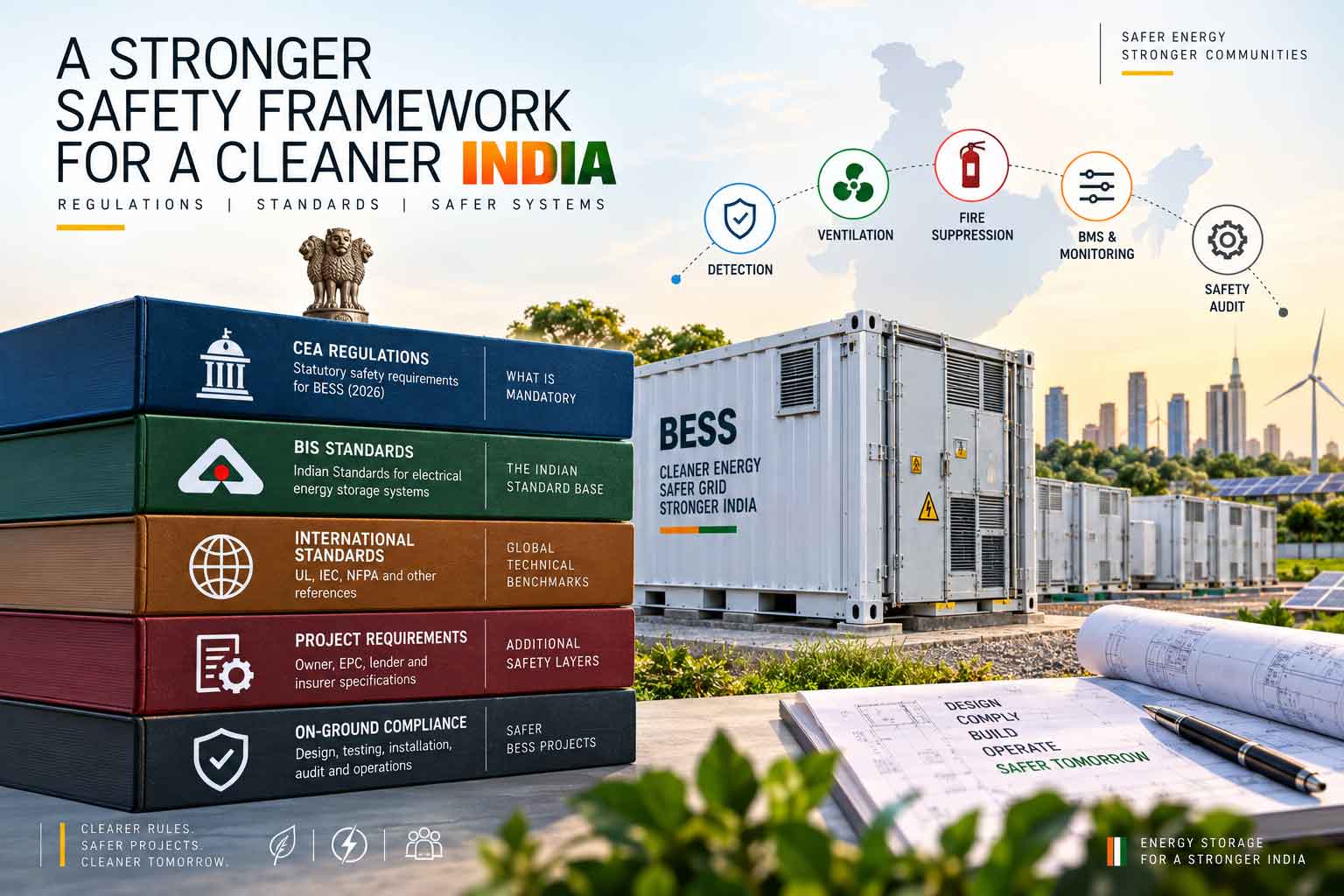
That means India’s BESS safety architecture is best understood as an evolving stack.
At the top sits the CEA regulatory framework.
Underneath are Indian Standards.
Then come applicable international standards and testing methods.
Then project-specific engineering requirements.
And beneath all of them is the actual physical installation.
If any layer is weak, the compliance document alone cannot make the system safe.
So, What Rules Actually Apply to BESS in India?
The short answer is:
CEA regulations
Provide the statutory electrical-safety framework, including the new BESS-specific Chapter XA from 1 April 2027.
BIS standards
Provide India’s technical standards for electrical energy-storage systems, including safety, testing and BMS requirements.
International standards
UL, IEC and NFPA documents can provide technical benchmarks or become applicable through project specifications, contracts or referenced requirements, but their status should be checked individually rather than assumed.
Fire/building requirements
NBC and applicable local fire/building requirements can form part of project compliance depending on the installation.
Project-specific requirements
Developers, EPCs, lenders, insurers and owners may impose additional requirements beyond the statutory baseline.
That is why there is no single document that can answer every BESS safety question.
The Real Gap Is Not “No Rules”
The debate around BESS safety in India sometimes gets reduced to a simple statement:
“India does not have BESS safety standards.”
That is no longer accurate.
India has:
- dedicated CEA BESS safety regulations;
- Indian EES safety standards;
- BMS standards;
- adopted IEC-based EES standards;
- a growing standards-development programme;
- BESS fire-audit work;
- dedicated training guidance for fire-safety officials; and
- increasing attention to system-level testing.
The more accurate concern is different:
India is still building the complete ecosystem needed to consistently test, certify, audit, enforce and operationalise those requirements at grid scale.
That is a much more useful question.
Can India’s BESS Safety Framework Keep Pace With Deployment?
India’s BESS pipeline is expanding rapidly. CEA maintains a dedicated database tracking the development and deployment of BESS projects, with project-status reports updated through July 2026 on its current portal.
The scale of deployment makes safety standards increasingly consequential.
A regulatory framework written for a small number of demonstration projects is one thing.
A framework supporting hundreds of large installations across different states, technologies, owners, EPCs and operating models is another.
The challenge now is consistency.
- Will the same safety expectations be interpreted consistently across projects?
- Will testing be sufficiently representative?
- Will auditors have the expertise to challenge documentation?
- Will fire services have the necessary training?
- Will safety requirements remain effective as battery chemistries and architectures change?
CEA’s provision allowing technical specifications for new BESS technologies through separate orders is one indication that the framework anticipates technological change.
The Bottom Line: Compliance Is Becoming More Specific
The Indian BESS industry has crossed an important line.
Safety is no longer simply a matter of applying generic electrical rules to a battery container.
The CEA’s 2026 amendment recognises BESS as a distinct safety category and introduces requirements covering fault tolerance, BMS, thermal management, ventilation, explosion protection, detection, fire suppression, emergency shutdown, separation, auditing and emergency preparedness.
At the same time, BIS is building out a broader Indian EES standards architecture, with nine published standards and ten more under development in its current ETD 52 programme.
But the industry still has work to do.
India needs the testing infrastructure to prove that large BESS installations behave safely under credible failure conditions. It needs independent technical expertise to interpret the standards. It needs trained responders who understand battery-specific hazards. And it needs project owners to treat safety as a lifecycle obligation rather than a commissioning certificate.
So, what rules actually apply?
The answer is not one standard.
It is a hierarchy:
CEA regulation → Indian Standards → applicable international standards → project requirements → site-specific engineering → independent verification.
And the most important question is not whether a BESS can produce a thick compliance file.
It is whether the physical system behind that file can withstand the failure scenarios it was designed to manage.
India now has a much clearer regulatory foundation for BESS Fire Safety Standards in India.
The next challenge is making sure those standards work—not just on paper, but inside the battery container, across the project site and, ultimately, when the grid needs the asset to remain safe.
 Electrify your feed! Click here to join our Whatsapp group and to get the latest updates, expert insights, and innovations driving India’s energy storage revolution.