If you’ve been tracking India’s energy journey, you’ve probably noticed something: the conversation has changed. It’s no longer just about building more solar parks or wind farms. The real “buzz” in 2026 is about storage. The latest India energy storage forecasts aren’t just promising growth—they are predicting a total transformation. Here is the lowdown on why the India energy storage market is about to become the heartbeat of our power ecosystem, and what that means for the industry.
The “500 GW” Reality Check
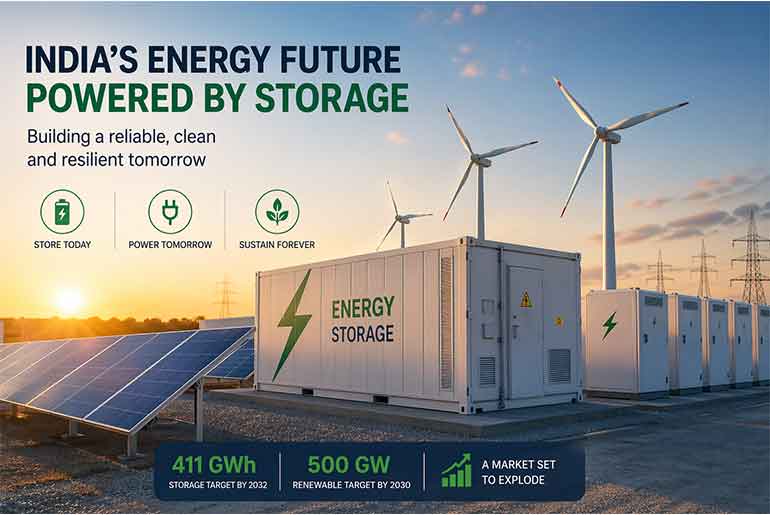
India is on a mission to hit 500 GW of renewable energy by 2030. That is a massive, world-leading goal. But here is the catch we all know: the sun sets, and the wind doesn’t always blow when we need it most.
As we add more green power, the “gap” between when energy is made and when it’s actually used is growing. This is where you—and the storage industry—come in. Storage isn’t just an “extra” anymore; it’s the bridge that makes round-the-clock (RTC) green power a reality.
Decoding the Numbers: The 411 GWh Goal
Let’s talk scale. According to the latest projections from the Ministry of Power and the CEA:
- By 2030: India will likely need about 218 GWh of storage.
- By 2032: That number jumps to a staggering 411 GWh.
To give you an idea of the opportunity, our current installed battery storage is still in the very early stages. We are looking at a tenfold increase in capacity for the energy storage in just a few years. This isn’t just growth; it’s a structural revolution.
What research firms are saying
If you look at global research firms, you will see the same story repeated with strong numbers behind it.
- According to Mordor Intelligence, India’s battery energy storage system (BESS) market is projected to grow from about USD 2.05 billion in 2026 to USD 8.59 billion by 2031, registering a strong CAGR of 33.2%.
- At the same time, Persistence Market Research estimates that India’s overall energy storage market will grow from around USD 3.7 billion in 2026 to about USD 21.8 billion by 2033, at a CAGR of 28.7%.
So when you look at both policy direction and market data, you see the same message.
The India energy storage market forecast is not just strong in theory—it is backed by real numbers and high growth projections from multiple sources.
What’s Changing in 2026?
We are moving past the “pilot project” phase. The market is shifting in three big ways for the India Energy storage market:
- From Small to Massive: We are seeing fewer “test projects” and more utility-scale deployments that can support entire cities.
- Hybrid is the New Standard: Projects are no longer “just solar” or “just wind.” The new winners are hybrid systems that combine generation and storage into one high-efficiency package.
- The Rise of Long-Duration Storage: While 2-hour batteries were the focus until recently, the grid now needs 4-hour to 8-hour storage to manage evening peaks. This is opening the door for technologies beyond just lithium-ion, including Pumped Hydro and Sodium-ion.
The Policy Tailwinds
The government isn’t just watching from the sidelines. Initiatives like Viability Gap Funding (VGF) and the PLI Scheme for Advanced Chemistry Cells are designed to do two things: lower your upfront costs and make sure we aren’t just importing every single battery from abroad. They want “Made in India” storage to be the gold standard.
The Roadblocks (And Why They Matter)
We have to be honest: it’s not all smooth sailing.
- High Costs: Even with falling prices, the upfront investment for a big storage park is massive.
- Supply Chains: We still depend heavily on other countries for raw materials like lithium and cobalt.
- Grid Bottlenecks: Our distribution grids need to get “smarter” to handle all this new, two-way power flow.
India Energy storage market has moved from the “margins” to the mainstream. Every new solar or wind project being planned today has to have a storage strategy attached to it.
For you, this means the sector is wide open—from manufacturing and project development to the software that manages these complex energy flows. India isn’t just building a green grid; we are building a resilient, storage-enabled powerhouse.
The forecast is clear: India Energy Storage market is no longer a supporting actor. It’s the star of the show.
 Electrify your feed! Click here to join our Whatsapp group and to get the latest updates, expert insights, and innovations driving India’s energy storage revolution.