As the global energy landscape undergoes a tectonic shift from internal combustion to high-voltage intelligence, the assembly line has emerged as the ultimate frontier of industrial survival. In this high-stakes race where battery chemistries evolve faster than the hardware that houses them, most manufacturers are caught between the rigidity of speed and the chaos of change. At this very edge, Maestrotech stands as a beacon of “Modular Elasticity,” engineering future-proof automation that turns hardware into a living, adaptable asset.
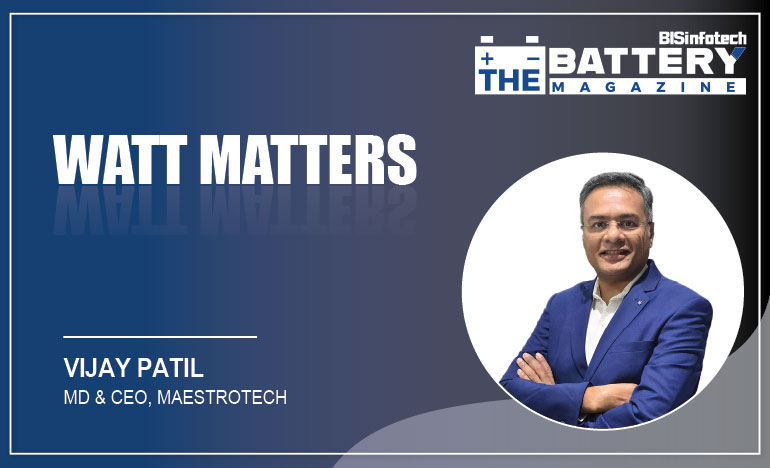
Shweta Kumari, Sub-Editor of The Battery Magazine, engaged in a thought-provoking discussion with Vijay Patil, MD & CEO of MAESTROTECH, to peel back the layers of this technical revolution. Patil highlights how Maestrotech is bridging the gap between human intuition and robotic discipline, redefining the “Made in India” label as a global benchmark for precision. To dive into the depths of “Chemistry-Agnostic” systems and the mastery of manufacturing physics, read on for the full strategic roadmap to 2030.
Maestrotech often speaks about “precision-driven production.” In the context of the evolving lithium-ion landscape, where does engineering intuition end and automation-driven absolute precision begin?
The Automation Ethos: Where Strategic Intuition Meets Robotic Discipline
Maestrotech, “Precision-Driven Production” is more than a slogan; it is a technical boundary. The core of their philosophy lies in understanding where the human mind excels and where it becomes a liability. At Maestrotech, the assembly process begins not with a machine, but with a strategy. Engineering expertise is the driving force behind the critical pre-production phases:
- Conceptual Design
- Technology Selection
- Turnkey Management
- Advanced Welding
- Total Traceability
You have been recognized for manufacturing excellence—how is Maestrotech contributing to redefining the “Made in India” label from a cost-driven proposition to a benchmark of global-quality automation?
From its foundations in Singapore (2013) and Pune, India (2014), Maestrotech has rapidly evolved into a global powerhouse for assembly automation. Achieving a remarkable 200% year-over-year growth for three consecutive years, the company is proving that Indian engineering is now the gold standard for the international EV and BESS markets. Maestrotech is shifting the narrative of Indian manufacturing from a “low-cost alternative” to Innovation-driven excellence.
To meet burgeoning global demand, the company has officially moved into a new, state-of-the-art production facility. This isn’t just about floor space; it’s about a concentrated hub of intellectual property. With a team of 150+ skilled members—including dedicated Mechanical, Electrical, and Control Engineers—Maestrotech has secured 3 registered patents for under the product segment of battery pack assembly line.
With over 150+ projects delivered to leading global OEMs such as JBM, HBL, SPML, OKAYA, Luminous, Electra EV, BATTRIXX, Forsee Power, Exicom, OLA, and Dhoot Automotive (Bajaj Chetak) etc. Maestrotech’s global reach extends across multiple continents.
With rapidly evolving cell formats—from cylindrical to prismatic and pouch—how do you design assembly lines that balance high-speed precision with the flexibility to adapt to future battery designs?
In the high-stakes world of battery manufacturing, the only constant is change. Manufacturers often face a paradox: the need for high-speed, dedicated automation versus the demand for flexible lines that can adapt to evolving cell chemistries and pack designs. Maestrotech resolves this tension through Modular Elasticity—a design philosophy that ensures today’s investment remains relevant for tomorrow’s technology.
- Versatile Cell & Module Compatibility: Whether it is EV, or BESS modules or 100Ah, 174Ah, 258Ah, 314Ah, 587Ah, 628Ah, 688Ah, Maestrotech systems are designed for “Minimum Changeover”. This allows manufacturers to pivot between different battery architectures without a total line overhaul.
- Adaptable Machine Units: Standalone units like the Compression Machine and Laser Welding Machine feature “Adaptability to Different Battery Pack Designs”. This modular elasticity allows for precision alignment and force measurement regardless of the pack’s physical dimensions.
Having worked across both traditional automotive and EV ecosystems, what is the most significant technical shift required when moving from assembling internal combustion components to high-voltage battery systems?
The global shift from Internal Combustion Engines (ICE) to Electric Vehicles (EV) is more than a change in fuel—it is a total reimagining of manufacturing physics. Maestrotech stands at the epicenter of this transition, providing the high-voltage expertise and automated infrastructure required for legacy manufacturers to pivot toward a sustainable future.
For decades, the automotive industry focused on mechanical tolerances and fluid dynamics. Today, the priority has shifted to electrical integrity and thermal management. Maestrotech facilitates this high-voltage shift by translating complex battery chemistry into reliable assembly processes.
- From Mechanical to Electrical Precision: Moving beyond simple assembly, Maestrotech specializes in high- voltage safety and precision. Their systems handle everything from Busbar Laser Welding to BMS integration, ensuring that the “heart” of the EV is both powerful and safe.
- Thermal Management Mastery: Transitioning to EV requires advanced cooling systems. Maestrotech’s lines integrate precise Thermal Paste Dispensing and automated gap-filler application, critical for maintaining battery health during rapid charging and high-discharge cycles.
A successful transition to EV isn’t limited to the battery pack alone. Maestrotech provides a holistic “High-Voltage” roadmap that covers the entire powertrain and charging infrastructure:
- The Power Behind the Drive: Beyond modules, Maestrotech designs specialized lines for Motor Controllers and DC-DC Converters, the “brains” that manage high-voltage energy flow.
- Closing the Loop with Charging: To support the EV lifecycle, they offer automated assembly for AC and DC Chargers, featuring modular, plug-and-play fixtures that allow for rapid scaling as infrastructure demands grow.
As next-generation chemistries like solid-state and sodium-ion batteries emerge, how adaptable is current automation infrastructure to remain relevant across evolving battery technologies?
The battery industry is currently in a state of “perpetual evolution.” As the market looks toward Solid-State Batteries (SSB), Sodium-ion, and advanced chemistries, the greatest risk for manufacturers is hardware obsolescence. Maestrotech eliminates this risk by building “Chemistry-Agnostic” systems designed to evolve alongside the next generation of energy storage.
Fact Sheet: The Maestrotech Edge
| Category | Achievement / Specification |
| Growth Metrics | 200% Year-on-Year Growth over the last 3 years. |
| Key Capability | Complete Assembly Automation Solutions for EV & BESS. |
| Technical Team | 150+ members; dedicated Design & Control Engineers. |
| Manufacturing Footprint | New state-of-the-art operational facility; 1.07 Lac sq. ft. capacity. |
| Upcoming – 1.7 lacs sq. ft. capacity. | |
| Global Footprint | Successfully serving 5 countries with automation solutions. |
| IP & Patents | 3 Registered Patents for specialized cell sorting machine technologies. |
| Core Clients | JBM, HBL, SPML, OKAYA, Luminous, Electra EV, BATTRIXX, Forsee Power, Exicom, OLA, and Dhoot Automotive (Bajaj Chetak) |
The energy transition is the greatest industrial challenge of our century. It requires a new kind of partner—one that understands the physics of energy, the discipline of automotive standards, and the agility of modern software.
Maestrotech Systems is that partner. From their hub in Pune, they are not just assembling batteries; they are assembling the confidence that the global mobility revolution needs to succeed.
As we look toward 2030, Maestrotech is no longer just an Indian success story—it is a global pillar of the energy transition.
Case Study 1: India’s First Fully Automated Bus Battery Line – JBM Group, Bawal, India
In 2022, Maestrotech partnered with JBM Group to develop a landmark 3.3 GWh capacity assembly line for prismatic cell-based battery packs (35 kW to 65 kW). This project represented a significant leap for the “Made in India” initiative, targeting both domestic and international markets.
Key Technical Pillars:
- Modular Versatility: The line handles diverse cell capacities (from 100Ah to 688Ah) with “Minimum Changeover” time.
- Precision Engineering: Integrated advanced laser welding and standalone compression machines that adapt to varying pack dimensions.
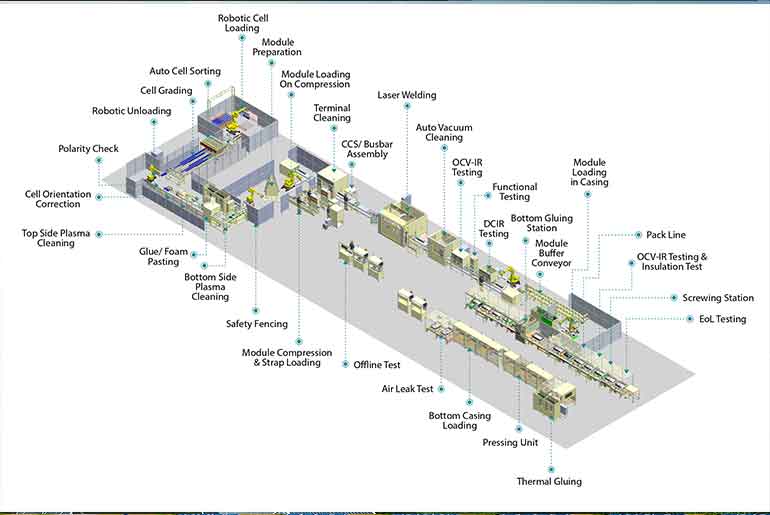
- End-to-End Automation: Complete process flow from automated cell sorting and stacking to final battery pack testing.
The Impact:
- Market Leadership: This became India’s first fully automated line for 65 kW bus batteries, enabling JBM to produce world-class batteries locally.
- High Throughput: Achieved an output of 7 to 15 packs per hour, meeting the aggressive demand of the electric bus sector.
- Operational Excellence: Full automation drastically reduced lead times, labor costs, and human error, while integrated data analytics ensured stringent quality control and safety.
Case Study 2: Precision Cell Sorting and Engineering Insights – Bajaj Auto Ltd., Aurangabad, India
For Bajaj Auto, the manufacturer of the Chetak electric scooter, Maestrotech designed and implemented a Fully Automated Cell Sorting Machine. This project went beyond simple assembly, providing deep engineering insights into the behavior of cylindrical cells during high-volume production.
Engineering Breakthroughs & Insights:
- The Testing Effect: Collaboration with Bajaj’s R&D revealed that repeat testing with a Hioki tester (10,000Hz) slightly energizes cells, causing voltage to increase and resistance to decrease.
- Thermal Discipline: Identified that resistance measurements fluctuate with temperature, leading to a recommendation for climate-controlled testing environments to ensure grading accuracy.
- Integrity-First Handling: Unlike gravity-fed systems that risk denting cells or altering internal chemistry, Maestrotech utilized non-impact, controlled pick-and-place movements to preserve cell health.
Key Metrics:
- Automated Sorting: Parameters include Voltage, Internal Resistance (IR), and K-value.
- Full Traceability: Every single cell is logged into a comprehensive data system for long-term quality tracking.
- Custom Integration: Tailored specifically to Bajaj’s throughput requirements and existing line architecture.
 Electrify your feed! Click here to join our Whatsapp group and to get the latest updates, expert insights, and innovations driving India’s energy storage revolution.