Across conference halls, policy tables, and industry forums, a quiet but decisive shift is underway. At the Bharat Electricity Summit 2026 and conversations around stationary energy storage, one message echoed consistently—India’s energy transition is no longer just about adding renewable capacity, but about managing it effectively.
This shift is not limited to India. Globally, energy storage deployment is accelerating at an unprecedented pace. In 2025 alone, more than 106 GW of new storage capacity was added worldwide, reflecting a 43% year-on-year growth. China now accounts for over half of global installations, while the United States and Europe continue to scale grid-level storage to manage renewable variability.
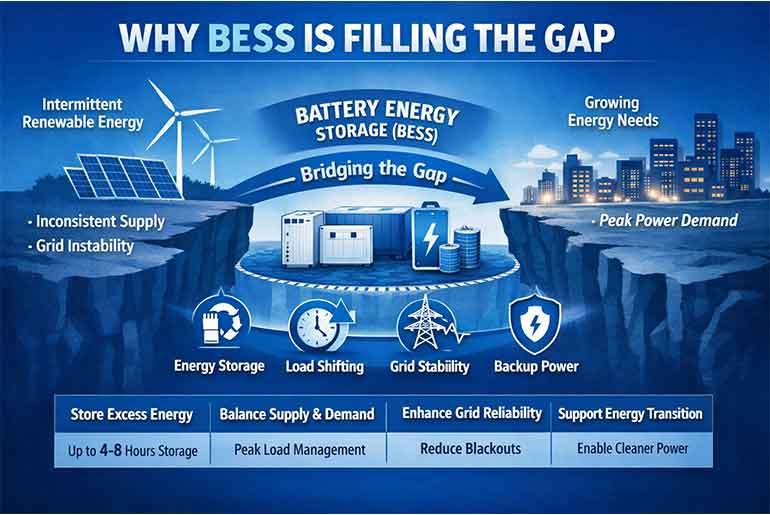
The reason is simple: renewable energy, while clean, is inherently intermittent. Solar generates during the day, wind is unpredictable, and demand rarely aligns with supply.
India is now entering the same phase. With an ambitious target of 500 GW non-fossil capacity by 2030, the country is rapidly expanding solar and wind capacity—but also encountering the same fundamental challenge: how to ensure reliable, round-the-clock power.
The global energy transition is no longer just about generating clean power—it is about managing it.
In this context, Battery Energy Storage Systems (BESS) have emerged as the critical link in the energy value chain, capable of bridging the temporal gap between renewable generation and consumer demand. The Central Electricity Authority (CEA) has identified a requirement for 41,650 MW/208,250 MWh of BESS capacity by the financial year 2029-30 to manage a grid where variable renewable energy (VRE) penetration is expected to reach 40% of total generation. This evolution is supported by a comprehensive ecosystem of domestic manufacturing incentives, fiscal reforms, and innovative market-clearing mechanisms designed to catalyze the next decade of India’s energy transition. Battery Energy Storage Systems (BESS) are emerging not as an optional add-on, but as the backbone of modern power systems—reshaping how energy is stored, dispatched, and delivered.
Arnab Saha – Senior Vice President, Business & Group Head – Strategy & Alliances, Geon
How do you see Battery Energy Storage Systems contributing to grid stability and renewable energy integration in India as the country accelerates toward its 2030 clean energy targets?
As India moves toward its 2030 green energy ambitions, Battery Energy Storage Systems (BESS) are emerging as an important enabler of grid stability and reliable power delivery. The country’s electricity demand is expected to exceed 1,900 TWh annually, creating increasing pressure on grid infrastructure to balance supply and demand in real time. In this context, energy storage provides the flexibility required to maintain stability while supporting a modern, resilient grid.
According to the Central Electricity Authority (CEA), India could require 336-411 GWh of energy storage capacity by 2030-32 to maintain grid reliability and support the evolving power mix. This highlights the scale of opportunity and the importance of advanced storage technologies in the country’s energy transition.
Battery storage plays several important roles within the grid ecosystem. It enables peak load management by storing electricity during periods of lower demand and releasing it during peak consumption hours. It also provides frequency regulation and voltage support, helping utilities maintain grid stability and prevent fluctuations that can disrupt power supply. The distributed storage systems, particularly lithium-ion-based solutions for homes, small businesses, and mobility ecosystems, can strengthen behind-the-meter resilience, reducing pressure on centralised grid infrastructure.
Lithium-ion technologies currently dominate the storage market, accounting for over 78% of installations due to their high energy density, efficiency, and falling costs. This makes them well suited for both grid-scale and distributed applications across residential, commercial, and mobility sectors.
For companies like us working in advanced lithium ion battery packs and energy storage, the focus today is on building scalable, safe, and intelligent storage solutions that can support grid flexibility while enabling electrification across sectors such as mobility, homes, and small enterprises. As India’s power ecosystem evolves, storage will increasingly serve as the backbone that ensures reliability, efficiency, and long-term energy security.
THE REAL PROBLEM: RENEWABLES WITHOUT STORAGE
The expansion of India’s renewable energy capacity—from approximately 81 GW in 2014 to nearly 275 GW in early 2026—represents one of the world’s fastest clean energy deployments. Solar power alone has seen a staggering increase from 2.8 GW to 143 GW within the same period. However, it is exposing the limitations of existing grid systems. While solar and wind are clean and scalable, they are inherently inconsistent.
- Solar power peaks during the day
- Wind energy remains unpredictable
- Electricity demand often peaks in the evening
This mismatch between when power is generated and when it is needed is now emerging as the biggest structural challenge for modern grids.
Globally, this imbalance is already visible. In high-renewable markets like California, the well-documented “duck curve” highlights excess daytime solar generation followed by steep evening demand spikes. According to the International Energy Agency, such fluctuations are increasing as renewable penetration grows, requiring greater system flexibility. In several high-renewable markets, peak ramp requirements have increased sharply, forcing grid operators to rely on fast-response balancing solutions.
India is beginning to experience similar pressures. In several renewable-rich states, instances of curtailment—where solar or wind power is generated but not dispatched—are becoming more frequent due to grid constraints. The Central Electricity Authority has indicated that large-scale integration of renewables will demand significant investments in balancing solutions, particularly energy storage.
At the operational level, maintaining grid stability is becoming increasingly complex. Under the Indian Electricity Grid Code (IEGC), the national grid is required to operate within a tightly controlled frequency band of 49.90 Hz to 50.05 Hz. Sustained deviations beyond this range can compromise system reliability, disrupt industrial operations, and in extreme cases, lead to outages.
As the share of variable renewable energy increases, these frequency fluctuations—triggered by sudden cloud cover or drops in wind generation—are becoming more frequent and harder to manage. This is creating a growing need for fast-response balancing solutions that can act in real time to maintain grid stability. BESS, with its millisecond response time, is uniquely positioned to provide frequency regulation and ancillary services that maintain the supply-demand balance. The technical superiority of BESS is further evidenced by its high round-trip efficiency (RTE), typically ranging between 80% and 90%, compared to 70% to 80% for PSP and 40% to 60% for Compressed Air Energy Storage (CAES).
At the same time, global grids are rapidly evolving toward flexibility-first systems, where the ability to store and dispatch power is becoming as important as generating it.
Renewables without storage do not just create inefficiencies—they can destabilize grids.
Rachit Garg, Director of Sales, Voltra Energy
As the adoption of renewable energy accelerates in India, what role do you see Battery Energy Storage Systems playing in improving grid reliability and enabling large-scale renewable integration?
I see Battery Energy Storage Systems (BESS) becoming a cornerstone of India’s evolving power ecosystem. While renewable capacity—especially solar and wind—has scaled rapidly, the intermittency of these resources continues to challenge grid stability. BESS provides a practical and scalable solution to bridge this gap. From our perspective at Voltra, storage is no longer an adjunct technology; it is integral to renewable project design. BESS enables time-shifting of energy—storing excess generation during peak production hours and dispatching it during demand peaks or renewable shortfalls. This not only smoothens supply variability but also reduces curtailment, ensuring that clean energy is utilized more efficiently. Equally important is the role of BESS in enhancing grid reliability. Fast-response capabilities allow batteries to provide frequency regulation, voltage support, and reserve capacity—services that are critical as conventional thermal plants gradually reduce their dominance in grid balancing. In regions with weak grid infrastructure, storage-backed renewable projects can significantly improve power quality and reliability. At Voltra Energy, we view BESS not merely as an enabling technology, but as the foundation for a more resilient, flexible, and future-ready grid. As India advances toward its clean energy ambitions, the ability to deliver reliable, dispatchable renewable power will define long-term success—and battery storage will be central to making that transition both practical and sustainable.
WHAT BESS REALLY IS
Battery Energy Storage Systems are often simplified as “large batteries,” but in reality, they are far more sophisticated. A BESS is not just about storing electricity—it is a fully integrated energy management system designed to control how power is stored, dispatched, and optimized in real time.
At its core, a BESS combines multiple technologies:
- Battery cells & racks – where energy is physically stored
- Battery Management System (BMS) – monitors performance, safety, and cell health
- Power Conversion System (PCS) – converts electricity between AC (grid) and DC (battery)
- Energy Management System (EMS) – acts as the brain, deciding when to charge or discharge
- Thermal & safety systems – ensure operational stability and prevent failures
These components work together to transform storage into an active grid asset, capable of responding instantly to fluctuations in supply and demand.
Modern systems are increasingly designed as integrated, intelligent platforms, enabling faster deployment, higher efficiency, and multi-functional use—from peak shaving to grid stabilization. This allows BESS to simultaneously perform multiple grid functions, including energy shifting, frequency regulation, and ancillary services.
Storage is not about storing power—it is about controlling power.
Savek Dubey, Assistant Manager – product Application, Sungrow India
From a technology and system integration perspective, what key innovations are shaping the next generation of Battery Energy Storage Systems for grid-scale renewable energy applications?
Technology and system integration perspective, the next generation of grid-scale Battery Energy Storage Systems (BESS) is being shaped less by incremental battery improvements alone and more by holistic, software-driven, and grid-interactive innovations.
- Shift from Component-Based to Fully Integrated Systems
Modern BESS integrates power conversion systems (PCS), battery management systems (BMS), energy management systems (EMS), thermal management, and fire safety into unified architectures.
Containerized and plug-and-play designs enable rapid deployment, scalability, and standardization across utility-scale projects. High-voltage DC architectures (~1500 V) and multi-MW PCS platforms improve efficiency and grid compatibility.
- Grid-Forming Capabilities and Advanced Power Electronics:
Next-generation systems are increasingly grid-forming rather than grid-following:
- Advanced inverters enable:
- Synthetic inertia
- Black-start capability
- Voltage and frequency stabilization
- BESS can now respond faster than conventional generation assets, making them critical for low-inertia renewable grids
- Multi-Service Operation and Revenue Stacking
System integration is increasingly aligned with multi-functional grid participation.
- BESS now supports:
- Peak shaving and load shifting
- Frequency regulation and ancillary services
- Renewable firming and capacity markets
- “Revenue stacking” models combine multiple value streams into a single asset.
- Long-Duration and Alternative Storage Technologies
Beyond lithium-ion, innovation is expanding system flexibility.
- Emerging technologies:
- Flow batteries
- Sodium-ion and other chemistries
-
Even lithium-ion systems are being pushed beyond traditional duration limits
TECHNOLOGY REALITY
As the energy storage market expands, one reality has become increasingly clear—the technology race is not wide open anymore. In grid-scale and stationary storage, one chemistry has quietly taken the lead: Lithium Iron Phosphate (LFP).
Today, most large-scale BESS deployments are shifting toward LFP, not because it is the most advanced—but because it is the most practical, reliable, and bankable.
Why LFP is dominating:
- Superior safety – LFP batteries are far more thermally stable and significantly less prone to thermal runaway compared to other lithium-ion chemistries
- Long lifecycle – typically 3,000–8,000 cycles, far exceeding many alternatives
- Lower lifecycle cost – longer life + lower degradation = better economics over time
- Material advantage – avoids cobalt and nickel, reducing supply chain risk
In contrast, Nickel Manganese Cobalt (NMC) batteries, while widely used in electric vehicles, play a more limited role in grid storage.
Where NMC still fits:
- Higher energy density – can store more energy in a smaller space
- Suitable for applications where space and weight constraints matter (EVs, mobility)
The Trade-off That Defines the Market
At the heart of this transition lies a fundamental trade-off:
- LFP → safety, stability, longevity
- NMC → energy density, compactness
While NMC can deliver up to 30% higher energy density, the gap reduces significantly at system level, making LFP more viable for stationary applications. Despite the rise of these new technologies, traditional PSP remains a vital component of the strategy; Tata Power, for example, is investing in 2,800 MW of PSP capacity in Maharashtra to provide 6 to 8 hours of storage by 2028.
For grid-scale storage, where space is less critical but reliability is non-negotiable, LFP has emerged as the preferred choice.
Sameep Agarwal, Co-Founder and Director, ENERVEDA VAULT LLP
As global renewable energy deployment accelerates, how do you see advanced energy storage technologies shaping the future of grid-scale storage and long-duration energy solutions?
For grid-scale storage today, LFP chemistry has already won. The debate is over. 6,000+ cycles, no thermal runaway, system costs under $150/kWh at scale, and a supply chain that is mature and global. Every serious grid-scale deployment from GUVNL tenders in India to utility projects in the US and Australia is LFP. This is the present, not the future.
The real technology question is long-duration anything beyond 6 to 8 hours of discharge. That is where LFP hits its economic limits. The contenders are flow batteries for 8 to 24 hour applications, iron-air for multi-day storage, and compressed air or gravity-based systems for seasonal or geographic-specific use cases. None of these are commercially mature yet at scale. They are 5 to 10 years from meaningful grid deployment.
What this means practically: the next decade belongs to LFP BESS at the grid and C&I level, combined with smarter grid software forecasting, dispatch optimization, ancillary services. Long-duration technologies will complement, not replace, this foundation.
For India specifically, the priority is not chasing next-generation chemistry. It is building reliable domestic supply of proven LFP systems at competitive cost which is exactly the gap the market has right now.
Technology shapes storage. But supply chains and bankability determine who actually wins.
Next-Generation Innovations
As Battery Energy Storage Systems scale across grids, innovation is no longer driven by battery chemistry alone. The real shift is toward intelligence, control, and system integration. This marks a clear shift from hardware-led innovation to software-defined energy systems.
Key advancements:
- AI-driven BMS – moving from monitoring to predictive control, enabling real-time diagnostics and lifecycle optimization
- Liquid cooling systems – improving thermal stability, enabling higher density deployments, and reducing safety risks in large-scale projects
- Predictive analytics – transforming BESS into data-driven assets that can optimize performance and reduce operational losses
- Grid-forming technology – allowing storage systems to actively stabilize grids by providing synthetic inertia, frequency control, and black-start capabilities
The Bigger Shift
BESS is no longer a passive storage asset—it is becoming a grid-interactive system.
As power systems evolve, the ability to respond, adapt, and stabilize in real time is becoming more valuable than simply storing energy.
The future of energy storage will be defined not by capacity, but by intelligence.
Ayush Misra, Co-Founder and CEO of Amperehour Energy
What technological innovations are currently shaping the next generation of Battery Energy Storage Systems in terms of safety, efficiency, and lifecycle performance?
The development talks on energy in 2026 have moved from power generation to power control, with Battery Energy Storage Systems (BESS) at the centre. As per IESA 2026 Report, India is at a “watershed moment,” with battery capacity expected to grow nearly ten times from 507 MWh in 2025 to 5 GWh by the end of 2026. This showcases a major transformation in how energy systems are designed and operated.
A key advancement lies in thermal management. This transformation from air cooling to liquid cooling has efficiently improved safety. Homogeneous liquid cooling helps prevent overheating, making it possible to build big projects like the 90 MW / 180 MWh one in Gujarat. Emerging innovations such as dielectric immersion cooling promise even lower auxiliary losses and enhanced safety.
Equally critical is the rise of AI-powered battery management systems, acting as a predictive “nervous system.” These systems help us with the assessments on a real-time basis, impedance analysis, predictive maintenance, forecasting cell degradation weeks in advance and optimising overall system performance.
Grid-forming (GFM) technology represents another major shift. Moving beyond traditional “grid-following,” modern inverters now provide virtual inertia, stabilising the grid independently. This is required to maintain frequency in stability while managing the expanding renewable storage, which includes 102 GWh of solar and wind contracts.
In the end, improvements in durability, which have reached over 15,000 cycles, along with declining prices (₹1.48 lakh/MW/month), are redefining project economics and allowing for lifespans of 30 to 40 years. Hardware-agnostic integration is essential in this changing environment to guarantee adaptable, intelligent systems that can smoothly balance energy shifting and grid support, creating a safer, smarter, and more resilient energy future for India.
India’s Emerging Energy Storage Market
India’s energy storage market is no longer in its early stages—it is entering a phase of rapid scale-up, driven by both policy push and grid necessity.
According to the Central Electricity Authority, India will require approximately:
- 411.4 GWh of energy storage capacity by 2031–32
- 236.2 GWh from BESS
- 175.2 GWh from pumped hydro storage
This projection reflects not just growth, but the structural dependence of future grids on storage.
Market Acceleration Signals
The pace of development has sharply accelerated:
- Battery storage capacity expected to jump from 507 MWh (2025) to ~5 GWh (2026) — nearly 10x growth in a single year
- Over 102 GWh of energy storage tenders issued in 2025 alone, with BESS accounting for ~60 GWh
- More than 224 GWh of cumulative tenders issued between 2018–2025
A large portion of this pipeline is now transitioning from tendering to execution, marking a critical inflection point for the sector.
IESA & Industry Outlook
Insights from India Energy Storage Alliance further reinforce this transition:
- Installed capacity (currently <1 GWh) is projected to reach ~346 GWh by 2033
- Nearly 92 GWh of BESS projects are already in pipeline
- The sector is expected to attract ₹4.79 lakh crore investment by 2032
At industry forums like SESI 2026, storage is now being positioned as a core pillar of grid reliability, not a supplementary technology.
Project & Deployment Momentum
- SECI has been actively issuing solar + storage and standalone BESS tenders
- NTPC and state utilities are scaling pilot and grid-level storage deployments
- Hybrid renewable projects (solar + wind + storage) are rapidly increasing
In fact, hybrid tenders have grown from ~12% in 2021 to over 49% in 2024, reflecting a structural shift toward firm power
Nishant Arya, Vice Chairman, JBM Group
How do you see domestic battery manufacturing and integrated battery ecosystem development influencing the scalability, cost competitiveness, and long-term growth of Battery Energy Storage Systems in India?
“The scalability and long-term sustainability of battery energy storage systems in India would be largely dependent on domestic battery production and the creation of an integrated battery ecosystem. By 2032, India is expected to need 411.4 GWh of energy storage, including 236.22 GWh from BESS. This shows how big the opportunity is and how urgent it is to develop local capabilities.”
“A robust local environment can enhance supply-chain resilience, lessen reliance on imports, and generate more value domestically. India will lay the groundwork required to scale BESS in a more competitive and sustainable manner as it develops skills in cell production, system integration, recycling, and associated technologies.”
“This momentum is further supported by policy measures, with the Ministry of Power announcing the second tranche of Viability Gap Funding (VGF) for standalone BESS projects. Following the first tranche supporting 13.2 GWh of capacity, the second aims for an additional 30 GWh, signalling a strong and sustained push towards large-scale energy storage adoption in India. Converting this policy momentum into a fully integrated battery ecosystem that can assist India’s energy transformation and solidify its standing as a globally competitive clean energy manufacturing hub is the true opportunity going forward.”
The Manufacturing Ecosystem: India’s ACC PLI Reality Check
To reduce import dependency and build a domestic battery ecosystem, the Ministry of Heavy Industries (MHI) launched the Production Linked Incentive (PLI) Scheme for Advanced Chemistry Cell (ACC) Battery Storage in May 2021.
- Total Outlay: ₹18,100 crore ($2.08 billion)
- Target: 50 GWh domestic ACC manufacturing capacity
Scheme Design & Requirements
- Technology-agnostic approach
- Incentives linked to:
- Higher energy density
- Longer cycle life
- Domestic Value Addition (DVA) Mandate:
- 25% within 2 years
- 60% within 5 years
Objective: Build end-to-end local battery ecosystem, not just assembly
Ground Reality (as of Early 2026)
Despite strong policy intent, execution remains limited:
- Target capacity: 50 GWh
- Commissioned capacity: ~1.4 GWh (only 2.8%)
- Operational player: Ola Cell Technologies
Structural Bottlenecks
- ~100% dependence on imports (cells + raw materials like lithium, cobalt)
- Lack of domestic manufacturing equipment ecosystem
- Delays in technical expertise availability (especially foreign specialists)
- Slow execution of giga-scale facilities
Industry Reality Check
- India’s battery manufacturing ecosystem is still in early development stage
- Analysts estimate:
- 5–10 years to achieve global competitiveness
- Policy support likely required:
- Basic Customs Duty (BCD)
- Anti-dumping safeguards
Real Applications: Ground Reality
Beyond policy and projections, the real story of BESS is unfolding on the ground—where adoption is being driven not by ambition, but by economics and reliability.
Today, energy storage is finding traction across multiple real-world applications:
- Commercial & Industrial (C&I) segment – businesses are deploying BESS to manage energy costs and ensure uninterrupted power
- Diesel Generator (DG) replacement – reducing dependence on costly and polluting backup systems
- Microgrids & distributed energy systems – enabling reliable power in remote or weak-grid areas
- Peak shaving & load shifting – storing power during low-tariff periods and using it during peak demand
The Shift Toward ROI-Driven Adoption
What is driving this adoption is not just sustainability—but clear financial returns.
- Rising diesel costs are making DG replacement increasingly viable
- Time-of-Day (ToD) tariffs are encouraging energy shifting
- Improved battery economics are shortening payback periods
As a result, BESS is no longer being deployed as an experimental technology, but as a cost-optimization and reliability solution.
In India, energy storage adoption is not being pushed—it is being pulled by economics.
Kartik Hajela, Director at Jupiter Electric Mobility (JEM)
With the recent development of modular BESS platforms in India, how do you see energy storage solutions transforming applications such as renewable integration, diesel generator replacement, and energy management for commercial and industrial sectors?
Modular BESS platforms are gaining traction but with high penetration in C&I segments. Air cooled and Liquid cooled systems for. 100kW-1MW application markets in DG reduction, Energy shifting in high TOD markets and Mobile BESS are gaining traction. At JEM Energy we are one of the few who are providing such solutions and have deployed already 15+ systems at various type of customer profiles and end usecases. Ranging from DG reduction, Microgrid, UPS application. We are one of the few companies globally to have deployed a 1 hr BESS product at a scale of 5MW offering specialsied thermal engineering. We see C&I market becoming a strong ground for modular platforms of BESS but still there is some time till when these platforms will be standardised with a standard supply chain built around. Companies are currently bringing scaled up modular design like 125kW/261kWh BESS cabinte from China and distributing in India but at JEM we as of now have been customized most of our systems to make sure end client achieves the perfect ROI for their use case. We feel after doing 50+ systems, few will emerge as the final standardised India specific BESS platforms rather than the current China driven systems coming to India.
Economics of Energy Storage (Sharp Analysis)
The economics of energy storage are undergoing a structural shift—from a cost burden to a value-generating asset.
At the core of this transition is the concept of LCOS (Levelized Cost of Storage), which measures the total lifecycle cost of storing and dispatching electricity. Unlike upfront capex, LCOS reflects real project viability—and this is where the change is most visible.
Falling Costs, Rising Viability
- Battery storage costs have fallen by nearly 90% since 2010, driven by scale, manufacturing efficiency, and technology improvements
- Average system costs are now around $120–125/kWh globally (2025)
- In some large-scale markets, core equipment costs have dropped to ~$75/kWh, signalling rapid cost compression
At the system level, LCOS for battery storage is now estimated in the range of $65–110/MWh, depending on project configuration
The Tipping Point: Storage vs. Peaker Plants
Historically, grid flexibility was provided by gas peaker plants—high-cost, low-utilization assets used during peak demand.
That equation is now changing:
- Battery storage (4-hour systems): ~$78/MWh
- Gas peaker plants: ~$120–220/MWh
This 30–50% cost advantage, combined with faster response times and zero fuel risk, is pushing storage ahead as the preferred solution for peak demand and grid balancing.
Revenue Stacking: The Real Value Driver
What makes BESS economically compelling is not just cost reduction—but multi-revenue capability:
- Energy arbitrage (buy low, sell high)
- Frequency regulation
- Capacity markets
- Renewable firming
Globally, storage projects are increasingly being designed around “revenue stacking”, allowing a single asset to generate multiple income streams.
Also, a major shift in the economics of energy storage came with the Government of India’s GST reforms announced on September 22, 2025. The GST rate on solar power generating systems—including panels, inverters, and batteries—was reduced from 12% to 5%, significantly lowering project costs.
The reform also corrected a long-standing tax distortion in battery technologies. Earlier, lithium-ion batteries were taxed at 18%, while other chemistries such as lead-acid and flow batteries attracted 28% GST. The revision aligned all non-lithium industrial batteries to the 18% bracket, creating a more level playing field across technologies.
For residential and C&I consumers, these changes translate into an estimated 8–10% reduction in total rooftop solar installation costs, directly improving project returns.
To further strengthen project viability, the Ministry of Power has expanded Viability Gap Funding (VGF) support. In June 2026, a second tranche of ₹5,400 crore was announced to support 30 GWh of standalone BESS capacity, in addition to the earlier ₹3,700 crore for 13.2 GWh. The waiver of ISTS charges for BESS projects commissioned before 2028 has further improved project economics for developers.
Together, these measures mark a decisive shift—energy storage is no longer just technologically viable, but increasingly financially supported at scale
Circular Economy: Waste Management & Recovery (Final Version)
As BESS deployment scales, end-of-life battery management is emerging as a critical challenge. India is projected to have nearly 600 GWh of cumulative lithium-ion battery capacity between 2022 and 2030, with around 128 GWh becoming available for recycling by the end of the decade.
To address this, the Ministry of Environment, Forest and Climate Change (MoEFCC) introduced the Battery Waste Management Amendment Rules, 2025, strengthening the Extended Producer Responsibility (EPR) framework.
- Mandatory recovery targets for critical materials such as lithium, cobalt, and nickel
- QR code/barcode-based tracking linked to a centralized CPCB portal
ensuring full lifecycle traceability of batteries
Complementing this, the government launched a ₹1,500 crore incentive scheme under the National Critical Mineral Mission (NCMM) (October 2025):
- 20% capex subsidy for recycling facilities
- Operational incentives on recovered minerals
- Target:
- 270 kilo tonnes annual recycling capacity
- 40 kilo tonnes critical mineral output
Incentive Structure
| Parameter | Group A (Large Recyclers) | Group B (Small/Start-ups) |
| Revenue Threshold | > ₹200 crore | < ₹200 crore |
| Minimum Investment | ₹100 crore | ₹25 crore |
| Facility Capacity | 10,000 tonnes/year | 5,000 tonnes/year |
| Max Incentive | ₹50 crore | ₹25 crore |
| Allocation (₹1485 cr total) | ₹990 crore | ₹495 crore |
Policy & Challenges (Critical Section)
India’s push toward energy storage is being actively shaped by a growing policy framework, but the transition from intent to execution remains complex.
Policy Momentum
Government bodies are increasingly integrating storage into the national power strategy:
- Ministry of New and Renewable Energy (MNRE) – promoting storage-linked renewable projects and pilot programs
- Solar Energy Corporation of India (SECI) – issuing large-scale tenders for standalone BESS and hybrid projects
- Viability Gap Funding (VGF) – introduced to support early-stage BESS deployment and improve project viability
These initiatives signal a clear shift—storage is no longer peripheral, but a core component of India’s energy planning.
Ground-Level Challenges
Despite strong policy intent, several structural challenges continue to slow large-scale deployment:
- High upfront capital costs – even with falling battery prices, initial investment remains significant
- Financing & bankability concerns – limited track record makes lenders cautious
- Import dependency – heavy reliance on global supply chains, especially for cells and components
- Lack of domestic manufacturing scale – ecosystem still developing across cells, systems, and recycling
- Regulatory uncertainty – evolving frameworks for tariffs, ownership models, and market participation
The Reality Check
India has laid the foundation for a storage-driven energy transition, but scaling it will depend on how quickly these structural gaps are addressed.
India has momentum—but execution remains its biggest challenge.
THE ROAD AHEAD
The next phase of the energy transition will not be won by those who generate the most renewable power—but by those who can control it. The year 2026 is projected to be the year when the Indian energy storage industry transitions from tendering to execution at scale. Approximately 5 GWh of BESS capacity is set to reach commissioning in 2026, following a 1.8X year-over-year increase in the storage pipeline during 2025.
Innovations such as “thermal-plus-BESS” tenders, led by NTPC, are opening new market segments by integrating storage with coal-fired generation to improve ramp rates. Furthermore, the discovery of monthly storage tariffs as low as ₹1.48 lakh/MW/month in APTRANSCO tenders and ₹1.85 lakh/MW/month in GUVNL Phase VII indicates that competitive price discovery is maturing. As Adani prepares to commission a 1,126 MW/3,530 MWh facility in Gujarat—one of the world’s largest single-location BESS projects—the focus will shift toward operational excellence, supply chain resilience, and the integration of grid-forming inverters to maintain stability in a non-fossil future.
The success of India’s energy transition ultimately depends on the harmonious integration of these disparate elements: the manufacturing of high-performance cells, the rationalization of taxes to ensure project viability, and the implementation of robust recycling frameworks to ensure long-term sustainability. BESS is no longer just a technical auxiliary; it is the fundamental infrastructure of the new Indian energy economy.
 Electrify your feed! Click here to join our Whatsapp group and to get the latest updates, expert insights, and innovations driving India’s energy storage revolution.