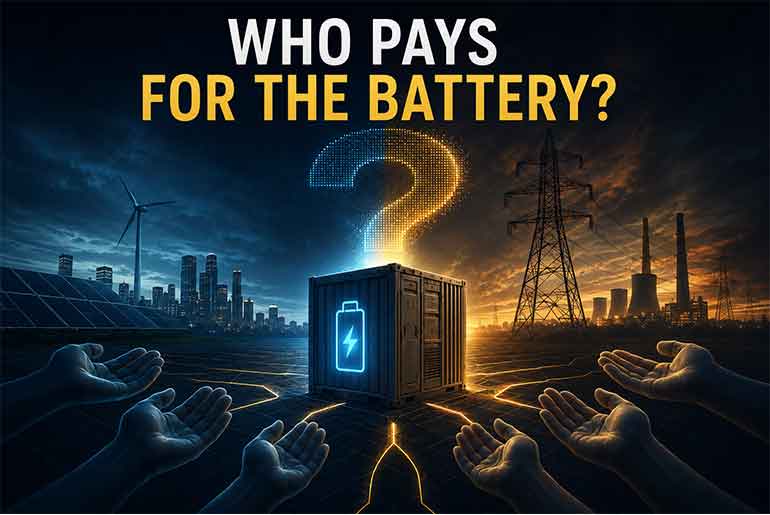
India is rapidly building a market for Battery Energy Storage Systems, but as batteries are asked to provide energy, capacity, flexibility and reliability, one question is becoming impossible to avoid: who actually pays for the battery?
India’s battery-storage story has moved far beyond the question of whether the country needs BESS.
The need is now firmly established.
India is building more renewable generation, electricity demand is rising, peak demand is becoming harder to manage, and the power system increasingly needs resources that can shift electricity across hours and respond quickly when conditions change. The government’s own planning documents project a substantial requirement for energy storage, while policy support has expanded through Viability Gap Funding, Energy Storage Obligations and Resource Adequacy planning.
But there is a difference between creating a requirement for storage and creating a bankable business for storage.
A battery can be technically capable of providing several services. It can absorb surplus renewable electricity, discharge during periods of high demand, provide fast-response grid support and contribute to resource adequacy. Yet each of those services has a different economic value, a different contractual structure and, potentially, a different payer.
That brings India to the next stage of its storage journey.
Who Pays for the Battery?
The question is deceptively simple.
A conventional power plant largely has a familiar commercial proposition: invest in generation capacity, produce electricity and sell it under a contract or into the market.
A BESS is different.
It does not necessarily generate electricity. It stores electricity and makes it available when it is more valuable or when the grid needs a particular service. Its value can therefore come from energy, capacity, flexibility, availability or grid-support services.
And that means the battery’s economics cannot be understood simply by asking how much a battery costs.
The more important question is:
What exactly is the customer paying the battery to do?
That distinction will determine whether India’s enormous BESS pipeline becomes a financially sustainable industry—or remains dependent on carefully structured contracts and government support.
India Has Built the Need for Storage. Now It Has to Build the Revenue
Our earlier analysis of India’s National Battery Storage Mission examined how storage is becoming an increasingly important part of the country’s electricity architecture.
Read our earlier analysis on India’s National Battery Storage Mission
Then came the question of viability.
India introduced VGF support specifically because the economics of early BESS projects were not sufficiently attractive to rely entirely on market revenues. The first major VGF programme supported 13,850 MWh of BESS with a budgetary allocation of ₹3,760 crore, while a subsequent June 2025 scheme provides ₹5,400 crore of support for 30 GWh through the Power System Development Fund.
The second scheme allocates 25 GWh to 15 states and 5 GWh to NTPC. As of a March 2026 government update, Letters of Award had been issued for 17.1 GWh, but no VGF had yet been disbursed because the projects had not reached the required milestone for release.
That last detail is important.
It reminds us that a government allocation is not the same thing as money already flowing into projects.
Then India created another mechanism to create demand.
The Energy Storage Obligation requires obligated entities to progressively incorporate storage into their electricity planning.
And Resource Adequacy planning adds another layer: storage is increasingly being viewed not merely as a technology but as part of the dependable capacity needed to keep the power system reliable.
So the policy chain is becoming remarkably clear:
Need → support → obligation → reliability requirement
But there is still one missing question:
Who Pays for the Battery?
A Battery Is Not Selling Just Electricity
This is where BESS economics become fundamentally different. Consider a battery connected to a renewable project. At noon, solar generation may be abundant. The battery can charge. In the evening, solar output falls while electricity demand remains high. The battery can discharge.
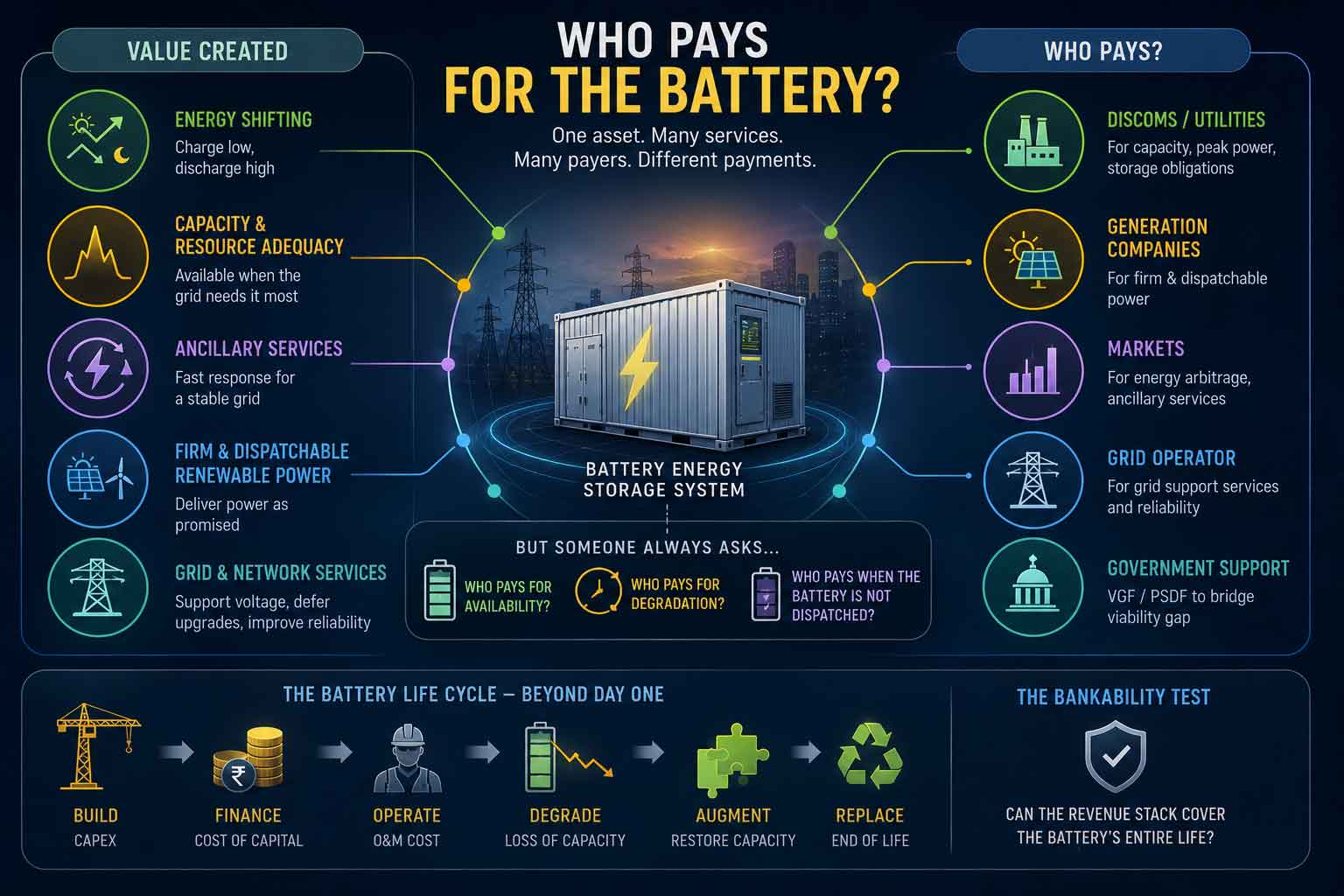
In another situation, the grid may require a fast-response resource to help balance the system. In another, a battery may need to remain available to meet a contracted peak requirement. The physical asset is the same. The service is not. That creates several potential value pools for BESS.
Energy shifting
The battery can move electricity from one period to another.
Capacity
The battery can be available during periods when the system needs dependable capacity.
Ancillary services
The battery’s fast-response capability can support grid balancing.
Firm and dispatchable renewable power
Storage can help renewable projects deliver electricity according to a specified supply profile rather than simply when the sun shines or wind blows.
Grid support
Storage can potentially provide services associated with flexibility and system operation.
India’s regulatory framework already recognises storage as more than an energy-shifting asset. The Ministry of Power’s BESS guidelines cover storage as part of generation, transmission and distribution assets and alongside ancillary services.
The challenge is turning those technical capabilities into predictable cash flows.
Who Pays for Energy Shifting?
The simplest BESS business case is energy arbitrage. The battery charges when electricity is relatively inexpensive or when surplus renewable energy is available and discharges when electricity has greater value. In theory, the battery earns from the spread. But the spread is not the profit.
The project must also account for:
- round-trip efficiency losses;
- battery degradation;
- financing costs;
- operating costs;
- availability requirements;
- replacement or augmentation;
- market access;
- transmission and other applicable charges.
This means that a large difference between charging and discharging prices does not automatically translate into an attractive BESS project.
And it explains why merchant BESS remains a much more exposed proposition than a battery operating under a long-term contracted structure. A merchant battery essentially asks the market to provide enough value, often without the same certainty offered by a long-term capacity or storage contract.
That makes the question “Who Pays for the Battery?” much sharper in a merchant model.
The answer may simply be:
the electricity market—if the market provides sufficient and sufficiently predictable spreads.
That is a very different proposition from a contracted BESS.
Who Pays for Capacity?
This is where the connection with our Resource Adequacy story becomes important. A battery may have value even when it is not continuously discharging.
Why?
Because its availability itself can have value.
If the system expects a high-demand period, having a battery capable of delivering power during that period can contribute to resource adequacy.
That means the buyer may not simply be purchasing units of electricity.The buyer may be purchasing availability and dependable capacity. This is already visible in India’s BESS procurement architecture.
The commercial structure for standalone BESS projects can involve capacity-based payments rather than a conventional electricity tariff. The Odisha procurement, for example, is for a 125 MW/500 MWh standalone BESS supported through VGF, with SECI acting as the implementing agency for the competitive procurement. SECI’s tender documents show the project as a dedicated standalone BESS procurement rather than simply a conventional renewable-energy PPA.
And the project reached the successful-bidder stage in July 2026.
This is significant because it demonstrates how India is beginning to translate the abstract value of storage into a contracted commercial product.
The battery is not merely saying:
“I will sell you electricity.”
It is effectively saying:
“I will provide a defined storage capability that you can rely on.”
That is a fundamentally different commercial proposition.
Who Pays for Ancillary Services?
This is another potential revenue source for BESS. Battery systems are particularly suited to fast-response applications, and India’s regulatory architecture has provisions for ancillary services. But there is an important distinction between being technically eligible to provide a service and earning enough revenue from that service to finance a large project. CERC’s regulatory framework has established mechanisms for ancillary services, while the Commission continues to examine the evolution and redesign of India’s ancillary-services mechanism.
That means the ancillary-services market should be treated as an important developing revenue opportunity, not automatically as the financial foundation of every BESS project.
This distinction matters.
Because it is easy to look at a battery and say:
Energy + capacity + ancillary services + grid support = four revenue streams.
But that does not necessarily mean:
four independent cheques.
Revenue Stacking Sounds Easy. It Isn’t.
This is perhaps the biggest misconception around BESS economics.
A battery can technically perform multiple functions.
But it cannot necessarily perform all of them simultaneously.
Suppose a battery is contracted to provide peak capacity at 7 pm.
If it has already discharged heavily earlier in the day for energy arbitrage, will it still have enough state of charge to meet the peak commitment?
If the battery is reserved for an ancillary service, can that same capacity simultaneously be committed elsewhere?
If additional cycling increases degradation, who pays for the additional battery wear?
This is why revenue stacking should not be confused with simply adding up multiple potential revenue streams.
The commercial contract has to define:
- dispatch priority;
- availability;
- state-of-charge requirements;
- cycling limits;
- performance guarantees;
- degradation assumptions;
- compensation;
- penalties;
- augmentation responsibility.
So the real question is not:
Can one battery provide five services?
It is:
Can one battery provide those services without creating conflicting contractual obligations—and can the combined revenue compensate the asset for doing so?
That is the real BESS bankability test.
Falling Battery Costs Help—but They Don’t Solve Everything
India’s BESS economics are changing rapidly.
The Ministry of Power reported in late 2025 that competitive bidding had produced a significant reduction in discovered BESS costs, with one comparison showing costs falling from around ₹10.18/kWh for two cycles per day in 2022–23 to around ₹2.1/kWh without VGF in more recent bidding, with the Ministry also citing an estimated ₹2.8/kWh at 1.5 cycles per day.
That is a major shift.
But it would be a mistake to read ₹2.1/kWh as “the cost of BESS in India.”
The economics depend on duration, utilisation, financing, project structure, degradation, support mechanisms and the precise procurement model.
And a lower battery cost does not eliminate lifecycle costs.
The battery still has to be financed.
It still has to operate.
It still has to maintain its contracted performance.
And eventually, parts of the system may need augmentation or replacement.
Which brings us back to the central question:
Who Pays for the Battery After Year One?
The Hidden BESS Cost: Keeping Capacity Available
A battery’s economics cannot be assessed only at commissioning. A project that promises a certain amount of usable capacity over 10 or 15 years has to maintain that capability. That makes degradation and augmentation central commercial issues. If a project is contracted to provide a specified power and energy capacity years into its operating life, the developer cannot simply say:
“The cells have degraded.”
The contract may require the project to maintain its performance. That can mean additional investment. And therefore, the original BESS tariff has to accommodate more than the initial equipment purchase. It has to support the whole life of the asset. This is particularly important for long-term capacity contracts.
The question becomes:
Who pays for augmentation?
Is it:
- the developer?
- the procurer?
- part of the fixed capacity charge?
- covered by a replacement reserve?
- built into the original financial model?
This is where BESS bankability becomes much more sophisticated than simply comparing battery prices.
VGF Can Close a Viability Gap. It Cannot Create a Revenue Stream
This distinction deserves emphasis. India’s VGF programmes are important because they can improve project economics and make competitive storage procurement possible. But VGF is fundamentally a support mechanism. It is not the same thing as a long-term revenue stream.
The government’s June 2025 VGF scheme provides ₹18 lakh per MWh for 30 GWh of BESS, amounting to ₹5,400 crore. The structure is designed to help projects become viable.
But after the support is provided, the project still needs a functioning commercial model.
The first question was:
Can public support close the viability gap?
The next question is:
What revenue keeps the project viable after that gap is closed?
That is the difference between project support and business sustainability.
Odisha Offers a Useful Glimpse of the Emerging Model
The 125 MW/500 MWh Odisha standalone BESS procurement gives us a particularly useful case study.
SECI’s tender describes the project as a standalone BESS procurement with VGF support through PSDF. The tender was issued in December 2025, bids were invited through competitive procurement, and SECI subsequently recorded a successful bidder in July 2026.
What makes this important is the structure.
The battery is not being developed simply because someone believes electricity prices will eventually become attractive enough.
Instead, policy support and procurement are being combined to create a defined commercial framework.
That is arguably the more important development in India’s BESS market.
The country is learning how to contract the value of storage.
And once storage becomes contractable, it becomes much easier for financiers to evaluate.
But that still leaves the question of who ultimately carries the payment obligation.
Who Pays When the Buyer Is a DISCOM?
This is where India’s broader power-sector financial health becomes relevant.
If a BESS is ultimately serving a distribution utility, the strength of the payment chain matters.
A battery developer may have an excellent technology, a competitive tariff and a long-term contract.
But lenders will still ask:
Who is the counterparty?
What is the payment-security mechanism?
What happens if payment is delayed?
Who stands behind the obligation?
This does not mean that DISCOM participation makes BESS unbankable.
It means counterparty risk and payment security become part of the bankability equation, just as they are elsewhere in the power sector.
And this is why a BESS contract can be commercially more valuable than a theoretical market opportunity.
A predictable contract can make it easier to raise capital than a potentially lucrative but uncertain merchant opportunity.
The Market Is Also Creating a Second Route: Firm Renewable Power
There is another important way batteries can be paid for without being treated purely as standalone storage.
They can be bundled into renewable projects that promise firm, dispatchable or peak-period electricity.
SECI’s procurement pipeline includes firm and dispatchable renewable-energy structures, including a tender for 1,200 MW of assured peak supply for 4,800 MWh, equivalent to 1,200 MW for four hours.
In such a structure, the customer may not care whether every rupee of the tariff is allocated separately to the solar plant, wind plant or battery.
The buyer wants the delivered electricity profile.
That changes the commercial conversation.
The battery becomes part of a larger product:
Firm renewable electricity.
And therefore:
Who pays for the battery?
Potentially, the buyer of the firm power is indirectly paying for the storage component embedded within that product.
This is one reason India’s future BESS market may not consist only of standalone battery tenders.
Merchant BESS: Can the Market Pay Without a Long-Term Contract?
This is where the industry’s next test could become particularly interesting. A merchant BESS does not necessarily depend on a single long-term contracted revenue stream. Its economics can instead depend on market opportunities.
That could include:
price arbitrage + ancillary services + other market opportunities
But the risk is obvious.
- Electricity-price spreads can change.
- Market rules can evolve.
- Competition can increase.
And if more batteries enter the same market, the very price spreads that initially created the opportunity could narrow.
So merchant BESS potentially offers greater upside—but also greater revenue uncertainty.
India will therefore need to discover how much storage can realistically be financed on market-based revenues and how much will continue to require long-term contracting.
That distinction will become increasingly important as battery costs decline.
The Payment Architecture Is Becoming More Important Than the Battery Price
This is perhaps the biggest lesson emerging from India’s BESS market.
For the first generation of projects, the question was:
How expensive is the battery?
Today, that question is increasingly being replaced by:
What is the total cost of delivering a guaranteed storage service for 10–15 years?
That includes:
CAPEX
↓
Financing
↓
Operation
↓
Efficiency losses
↓
Degradation
↓
Augmentation
↓
Replacement
↓
Contract compliance
The battery cell is only one part of that chain.
This is why two projects using apparently similar battery technology can have very different economics.
India Has Created Demand. Now It Needs Bankable Revenue
The progression of India’s storage policy is becoming increasingly logical.
The country’s storage strategy establishes the need.
VGF addresses part of the early viability challenge.
ESO creates a regulatory demand signal.
Resource Adequacy establishes the value of dependable capacity.
But now comes the commercial layer.
Who Pays for the Battery?
Because a policy target cannot repay debt. A storage obligation cannot, by itself, cover battery degradation. A resource-adequacy requirement cannot automatically create project cash flow. And VGF cannot replace a sustainable business model. Ultimately, someone must pay for the service the battery is providing.
So, Who Pays for the Battery?
There is no single answer.
And that is precisely the point. The emerging Indian BESS market is developing several payment pathways. A market participant may pay for energy value. A procurer may pay for contracted storage capacity. A renewable-energy buyer may indirectly pay for the storage required to deliver firm or peak electricity. The ancillary-services mechanism can create payments for eligible balancing services.
Government support can reduce the upfront viability gap. And in some future models, multiple market and contracted revenues could potentially be combined. But these are not interchangeable revenue streams. They carry different levels of certainty. They have different counterparties. They expose developers to different risks. And they place different responsibilities on the battery owner. That means India’s real BESS challenge is no longer simply about building enough batteries.
It is about designing revenue architecture that recognises what batteries actually provide to the electricity system.
The Battery’s Real Product Is Reliability
India’s storage story has moved through several stages.
First:
Why do we need storage?
Then:
How do we make storage viable?
Then:
How do we create demand for storage?
Then:
How much dependable storage does the grid actually need?
Now comes the commercial question:
Who Pays for the Battery?
The answer will determine how India’s storage industry evolves.
If batteries are paid only for the electricity they discharge, some of their system value could remain unmonetised.
If capacity, flexibility and ancillary services are properly contracted and valued, BESS could develop multiple bankable revenue pathways.
If those revenue streams remain uncertain, projects may continue to depend heavily on long-term contracts and government support.
And if revenue stacking becomes possible without creating conflicting obligations, the economics could become even more attractive.
But none of this should be assumed.
The Indian storage market is still developing its commercial architecture.
What is clear is that the battery itself is no longer the whole story.
India can build cells.
It can build BESS.
It can tender gigawatt-hours.
It can provide VGF.
It can impose storage obligations.
It can plan for resource adequacy.
But ultimately, a battery is a long-lived infrastructure asset.
It needs a long-lived economic model.
The real question is no longer whether India needs the battery.
It is whether India has built a market capable of paying for everything that battery is being asked to do.
And that is why, as India’s BESS pipeline expands, the most important question may remain the simplest one:
Who Pays for the Battery?
 Electrify your feed! Click here to join our Whatsapp group and to get the latest updates, expert insights, and innovations driving India’s energy storage revolution.