As India accelerates its journey toward electric mobility, energy storage, and advanced battery manufacturing, the spotlight often falls on cell chemistry, gigafactories, and battery technologies. Yet behind every high-performance battery lies an equally critical foundation—precision manufacturing, intelligent automation, and digital infrastructure capable of delivering quality at scale. In the race to build a globally competitive battery ecosystem, manufacturing intelligence is rapidly emerging as the industry’s true differentiator. At the centre of this transformation stands DNA Technologies, a company that has evolved from an automation solutions provider into a key enabler of India’s next-generation battery manufacturing ecosystem. By combining robotics, Manufacturing Execution Systems (MES), intelligent process control, and advanced battery assembly solutions, the company is helping manufacturers transition from conventional production methods to fully connected, data-driven factories.
As the industry moves toward large-scale ACC battery production, Battery Energy Storage Systems (BESS), and smart energy infrastructure, DNA Technologies is positioning itself at the intersection of manufacturing excellence and energy innovation. Its vision extends beyond automation equipment to building the digital backbone required for India’s energy future.
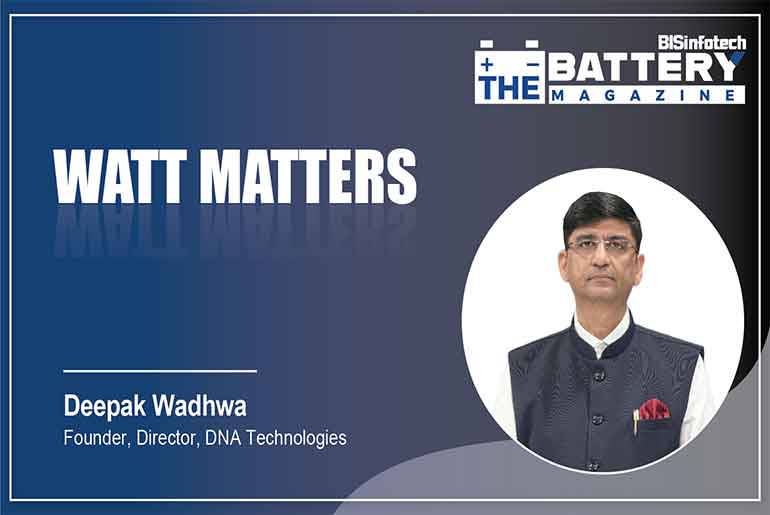
Against this backdrop, Shweta Kumari, Sub-Editor of The Battery Magazine, engaged in an insightful conversation with Deepak Wadhwa, Founder and Director of DNA Technologies. During the discussion, he shared his perspectives on intelligent manufacturing, battery automation, MES-driven traceability, localized robotics, BESS deployment, and the engineering challenges that will define India’s battery industry in the years ahead.
Let’s delve deeper into the conversation.
DNA Technologies has evolved from a power vision in 2017 to a multi-state automation leader in 2026. How has the philosophy of “Intelligent Manufacturing” changed the way Indian players approach battery pack assembly?
Since 2017, the Indian lithium battery industry has undergone a major transformation. Earlier, battery pack assembly was heavily dependent on manual operations and semi-automated processes. However, with the rapid growth of EVs and energy storage systems, manufacturers realized that battery performance depends not only on chemistry but also on manufacturing precision, traceability, automation, and quality consistency.
At DNA Technologies, we believe intelligent manufacturing is not just about automation; it is about creating a smart, connected, and data-driven production ecosystem. Today, manufacturers are focusing on MES integration, robotic precision, real-time monitoring, process control, and thermal safety.
The industry has shifted from manpower-dependent production toward process-controlled manufacturing. Intelligent manufacturing has enabled Indian players to improve scalability, reduce rejection rates, maintain global quality standards, and compete internationally with higher confidence.
With the 2025 launch of your BESS solutions, how is DNA Technologies bridging the gap between “Battery Manufacturing” and “Grid-Scale Energy Deployment”?
Battery Energy Storage Systems (BESS) are becoming one of the most important pillars of India’s renewable energy future. At DNA Technologies, our objective is not only to manufacture battery systems but also to create intelligent energy deployment infrastructure.
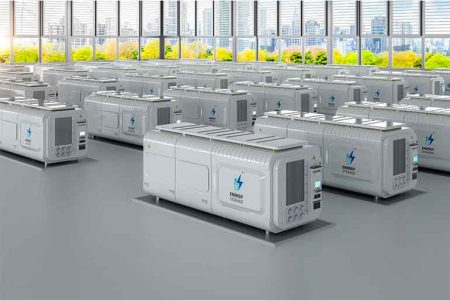
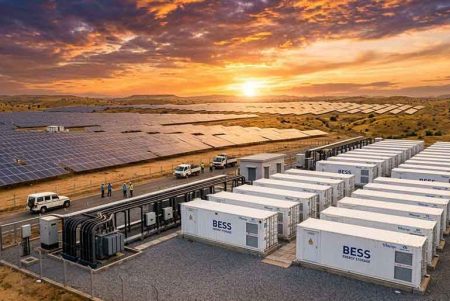
Our BESS solutions integrate automation, EMS (Energy Management Systems), thermal management, safety systems, and real-time monitoring into containerized energy storage platforms. We are focusing on creating scalable and reliable systems suitable for industrial, commercial, and utility-scale applications.
We believe the future of energy storage lies in intelligent and digitally managed systems that can improve grid reliability, renewable energy integration, and energy efficiency across multiple sectors.
You have heavily emphasized the Manufacturing Execution System (MES). Why is real-time production monitoring and traceability now a “non-negotiable” for Indian battery startups?
In today’s battery manufacturing environment, MES is no longer optional — it is essential. Global OEMs and customers now demand complete traceability and production transparency.
Every battery pack must have digital records including cell batch details, welding parameters, testing history, ageing reports, and operator traceability. Without MES integration, maintaining quality consistency at scale becomes extremely difficult.
At DNA Technologies, we emphasize MES because it improves production visibility, minimizes rejection rates, strengthens quality control, and ensures compliance with international manufacturing standards. In high-capacity battery manufacturing, even a minor production deviation can create major safety risks, making intelligent monitoring absolutely critical.
As a provider of both automation lines, which cell format do you see dominating the Indian Commercial & Industrial storage market by the end of 2027, and why?
Both Prismatic and Cylindrical cell formats have strong market potential, but we believe Prismatic cells will dominate the Indian Commercial & Industrial (C&I) storage segment by the end of 2027.
Prismatic cells offer better space utilization, higher energy density, modular flexibility, and improved integration for large BESS applications. They are particularly suitable for containerized energy storage systems where compactness and thermal management are important.
However, Cylindrical cells will continue to remain important for EVs and portable energy applications due to their mature ecosystem and cost advantages. At DNA Technologies, we are developing automation capabilities for both formats because future demand will remain application-driven.
Your recent partnership with Ranial Systems marks a shift toward Smart EMS. How will this collaboration enhance the “digital intelligence” of your containerized storage units?
Our collaboration with Ranial Systems represents an important step toward intelligent energy infrastructure. Modern BESS solutions require much more than energy storage; they require intelligent energy management.
Through this partnership, we are integrating smart EMS platforms, predictive diagnostics, remote monitoring systems, and real-time energy optimization technologies into our storage solutions.
This collaboration will improve operational safety, battery health monitoring, charging-discharging optimization, and overall system efficiency. It will also strengthen remote fault management and intelligent analytics capabilities for industrial and utility-scale energy storage systems.
While cell manufacturing is often the headline, automation hardware is still largely imported. How is DNA Technologies accelerating the “Make in India” mission for robotic assembly lines?
One of the biggest challenges in India’s battery ecosystem is the dependency on imported automation infrastructure. While significant focus is given to cell manufacturing, the manufacturing machinery and robotic systems are still largely dependent on foreign technologies.
At DNA Technologies, we are actively working toward strengthening the “Make in India” mission by developing localized automation solutions, engineering integration systems, and manufacturing infrastructure for lithium battery production.
Our focus is on reducing dependency on imported assembly systems while building India’s expertise in robotic automation, conveyor systems, laser welding integration, testing technologies, and smart manufacturing infrastructure.
Localization is not only about reducing cost; it is about building long-term technological independence and strengthening India’s industrial capabilities.
With the rise of high-nickel chemistries, how is DNA Technologies ensuring assembly accuracy and robotic safety to prevent thermal runaway risks?
As battery chemistries evolve toward higher energy density and high-nickel materials, manufacturing precision becomes extremely critical. Even a minor assembly error can increase the risk of thermal instability and safety failures.
At DNA Technologies, we focus heavily on robotic precision, intelligent inspection systems, thermal monitoring, controlled assembly environments, and multi-stage quality verification processes.
Our automation lines are designed to maintain high accuracy in welding, testing, insulation verification, and pack assembly. We also integrate process-controlled safety checkpoints and AI-assisted inspection technologies to improve manufacturing reliability and operational safety.
The future of battery manufacturing will depend not only on production speed but also on maintaining micron-level precision with maximum safety standards.
Looking ahead to 2030, what role will DNA Technologies play in the National Programme on ACC Battery Storage, and where do you see the biggest engineering challenge today?
India’s ACC Battery Storage mission represents one of the most important industrial opportunities of this decade. By 2030, the country will require large-scale manufacturing infrastructure, intelligent automation systems, advanced testing capabilities, and globally competitive production ecosystems.
DNA Technologies aims to contribute significantly through automation engineering, smart manufacturing infrastructure, BESS integration, and intelligent factory development.
We believe the biggest engineering challenge ahead is balancing rapid scalability with safety, localization, quality consistency, and energy efficiency. The industry must scale production without compromising manufacturing reliability and global compliance standards.
Our vision is to help build India into a technologically self-reliant global manufacturing hub for lithium-ion batteries, energy storage systems, and intelligent automation infrastructure.
 Electrify your feed! Click here to join our Whatsapp group and to get the latest updates, expert insights, and innovations driving India’s energy storage revolution.